Showing posts with label Tenth Doctor. Show all posts

Sunday, 29 November 2015

Fate of the Cybermen: The Cybermen of NuWho

Written 1/10/15.

This is Cyberman Month, where we've been looking at the original five black and white stories featuring Mankind's cyborg nemesis. I've also covered the five other Cyberman stories from the Classic Series, under Phillip Hinchcliffe in 1975 and later John Nathan Turner through the 80s. But what of the Cybermen now in the revival of the show? I've certainly covered all of the episodes, but it's often harder without hindsight to pinpoint the design and story changes which have brought the Cybermen from the swinging 60s into modern living rooms. So, in this article, I will be examining the history of the Cybermen in NuWho, and wondering where they might go from here.

This was in fact the first publicity image
of the Cybusmen. I love the head tilt.
The Cybusmen - 2006-9
Seen in: Rise of the Cybermen/Age of Steel, Army of Ghosts/Doomsday, Cyberwoman, The Next Doctor

Russell T Davies waited until the second series of the revived show to bring back the Cybermen, spending his first season giving a similar treatment to the Daleks. While they were made shiny gold and layered in a number of different political metaphors, the Cybermen were given an entirely new origin story. Instead of originating on Earth's twin planet Mondas, the Cybermen of an alternate universe originated on Earth itself, created by a disabled human scientist, John Lumic, who wished not only to end human pain and suffering, but also to prolong his own life and unite the world under the brand of his company, Cybus Industries.
     These Cybermen are strong, and sturdy, their design featuring a more angular face and a headplate which from behind recalls a roman helmet. Much was made of the Cybermen's reduction to "stampy metal robots," in the fan consciousness at the time, but this is somewhat unfair - if anything, these Cybermen harken back to the "boiler-suit" design from the middle three Sixties stories, except this time with a budget to fully execute the idea. While their voice was fairly memorable and well done (ta to Nicholas Briggs), they were imbued with a few new catch-phrases indicative of the change in their overall philosophy - "Delete", "Upgrade" and similar phrases likening their thoughts to computer software.
     That change in philosophy is a distinctly modern one. The original Cybermen were a reactionary fear to the use of cybernetics in medicine - artificial hearts, artificial limbs. They were the whole concept of prosthesis medicine taken to a logical extreme, in which a person's entire body is replaced and thus, in the eyes of Kitt Pedler and Gerry Davis, so is the soul. RTD's Cybermen - or the "Cybusmen" as fans call them - are an attempt to apply the same method to capitalism, more specifically to companies like Apple. Rise of the Cybermen sees everyone on the Alternate Earth owning a Cybus Industries "earpod" which downloads information directly into people's brains, and from this we can see the Cybusmen as a particularly heavy-handed message to not let corporations tell you what to think and what to feel.
Of course Chris Chibnall would give a Cyberman a metal bra
and heels. Talk about fetishes.
     But allegory aside, one area where I think that the Cybusmen excel over their previous incarnations is the fear and paranoia that they produce. Conversion between human and Cyberman was only actually seen in a single story of the Classic Series - the often derided Attack of the Cybermen. With the Cybusmen, we see the population of London marching into factories, waiting outside little cubicles, and then wandering in as their brain is surgically extracted from their body and placed into a Cybus Industries shell. It's obviously not as gory as I'm making it sound, but the whole idea of extracting and reprogramming the brain rather than slowly switching body parts means that becoming a Cyberman is an act of complete and utter dehumanisation. Some of my favourite moments from the Rise/Age two-parter came when the Cybermen ended up for one reason or another referring to their former selves, especially the Parallel Jackie Tyler, which just hits you as a gut-punch that this person, while not dead, is irreversible changed. It's fantastic.
     The Cybusmen within Series Two were at their most effective. I was glad that the show used them sparingly, and used them to influence a large part of the show's ongoing mythos. While Cyberwoman was quite, quite ridiculous, it had all of the body horror, all of the adult fears about losing the ones you love, and it also presented the whole idea of a single Cyber-conversion unit as a terrifying thing. While their execution in The Next Doctor was a little more experimental and weird, I think it was still an interesting use of the concept, and I can't really think of anything more awesome to do with your cybernetic guys than to stick them in Victorian England and make them create a slave-driven steampunk mecha. Oh. Yeah.

Hold on... that's a Preacher gun. From the Parallel Universe.
The Cybusmen never even wielded those, this is ridiculous.
The Fake Cybusmen - 2010-11
Seen in: The Pandorica Opens, A Good Man Goes To War, Closing Time, Nightmare In Silver (briefly).

Moffat's first move upon taking the show was to hoist a major redesign onto the Daleks, who had to be included at least once per year in order to fulfil the BBC's contract. However wise that decision was given that as of writing we just had a massive Dalek episode and not a single "New Paradigm" Dalek actually appeared, it led to the apparent explanation that the Cybermen couldn't be redesigned, because the budget had gone towards the new Daleks and the new Silurians. Why bother to bring them back, then, if it's going to be a continuity nightmare? Ha. Moffat doesn't care about keeping continuity within the show as he runs it, only in making references to Classic Who in some bizarre effort to please the fanbase.
     In this period of the Cybermen's history, there was a motion to distance the show from their alternate-universe origin, with the idea being that the Cybermen we were seeing were the originals from our Universe. However, the only concessions made to this were the removal of the "C" plate in the centre of their chests, and the fact that they now apparently have vast fleets of interstellar spacecraft that The Doctor can blow up as and when he pleases. Their catchphrases have changed as well, with at least one Cyberman screaming the Borg cry of "Assimilate" and for some ungodly reason having tentacles in its head. At least one fan theory espouses the idea that some of the Cybusmen remained in our universe at the end of Doomsday and found some of our Universe's guys, who decided to copy the design in the name of style.
Skulls are more funny than scary, particularly when they start
chattering at you. What's it going to do, bite you to death?
     The show attempted to make these Cybermen better in Closing Time, an episode which somehow managed to be the most disappointing thing in Series Six - no mean feat, I'll tell you. They had them skulking under a department store, kidnapping people, converting them and making the use of Cybermats for the first time since 1975. But, of course, they had to spoil it by having the Cybermen's weakness to emotion (admittedly weaponised by both The Invasion and The Age of Steel) become so absurd that the sound of a child crying for his father became enough to melt solid steel.
     It says a lot about the Moffat era that they simply didn't care enough to try and work out what these Cybermen were all about. There's no ideology behind them, no basis in any form of metaphor or idea, they are just cut-and-paste villains who borrow a lot of their catch-phrases from The Borg. Which, when you mention it, goes to describe our next lot...

Some Cybermen face designs look happy, others sad. These
are in a state of constant dumb surprise.
The Iron-Man-Borg-Lovechild - 2013-Present
Seen in: Nightmare In Silver, Time of the Doctor, Dark Water/Death In Heaven

The excitement when I saw the publicity photos for Nightmare In Silver was just ridiculously high. I love the Cybermen, and I love Cybermen stories, at least in principle. Every time there's a new Cybermen story or redesign I tell myself that this time, it's going to be good. It's going to work, there's going to be a point to them again. The Cybermen are best when they are both A.) working off of your fears about being robbed of your humantiy and B.) working as a metaphor for some aspect of ourselves that is leading us down a bad path. The best Cyberman stories have these elements, be it the original fear of medical technology in The Tenth Planet, of unguarded militarism in The Invasion, or of dehumanising Capitalism in Rise/Age. The most recent incarnation of the Cybermen? They are completely gone. Any hint of being about something is gone, and the Cybermen are now mostly just empty villains.
      Their initial appearance in the romance-novel-sounding Nightmare In Silver brings with it a lot of promise. Their design is given a technical upgrade when a "Cyber-mite" (evidently an evolved version of the Cybermats) absorbs and reverse engineers a newer piece of technology. The Cybermen which result from this have super-speed (an ability seen in a single sequence in their very first appearance and then never again) as well as the ability to both adapt to energy weapons as they're being fired upon and to assimilate people using tiny organisms. In other words, the Borg. I make this comparison a lot on this blog, and that's because it's perfectly warranted, especially after that episode., While the idea of a plague which could rob you of your humanity is still pretty scary in principle, it lacks the body-horror and deeply personal elements which make the Cybermen effective.
Death In Heaven returned some body horror to the Cybermen,
even if it went about it in a weird way.
     Ignoring the ridiculous wooden Cybermen of Time of the Doctor (fuck that episode, seriously), their next appearance was in last series' finale, Dark Water/Death In Heaven, where they have become tools of The Master. This two-parter did good and bad things with the concept. On the one hand, the whole idea of downloading the minds of the human race and resurrecting them in robotic shells is key to what made the Cybusmen work, and so that was really effective. What wasn't effective was this whole business of these new Cybermen apparently having an entire human corpse inside them, which seems to go against the entire idea of having them now so easily transferred via a "Cyber-virus". Why attempt to forcibly combine the two ideas, when the whole "downloading people" thing is scary enough? Having people actually rise from their graves as Cybermen with their original bodies and suggesting that one of them is The Brigadier is effing ridiculous. It made the episode funny rather then terrifying, which as is the case with Capaldi's stuff so far, it was a hair's breadth from being.

The Future

There were accusations flying around during the Wilderness years that any interesting things that could be done with the Cybermen had already been done, and not just in the show, but in the extensive material from the Expanded Universe. Then, Rise/Age appeared, an adaptation of the audio Spare Parts, which was an origin story for the Cybermen of our Universe, similar in style to the way that Genesis of the Daleks had breathed new life into the metal pepper pots by revealing their history and ideological purpose. Whether or not you believe that everything good from Rise/Age came from Marc Platt and Spare Parts, I don't think that there is a Cyberman story which better combines a really good origin for the Cybermen, a set of body-horror moments which scare and unsettle, with what is a fairly decent adventure story.
The one on the right has discovered that her husband Gerald
is having an affair with the pool boy, and the one on the left
was the one trying to cover it up.
     There are so many possible stories that you could develop using the Cybermen from either Universe which would be fulfilling to a purpose of some sort, and genuinely fun at the same time. We don't need a full history lesson a la Attack to explain where they've come from - if necessary, just stick in some minor background dialogue, because the people who notice that stuff will love it and people who don't will love the story for being a good story. The Cybermen have always been for me the dark mirror of humanity, always a vision of what we may become, either literally or in metaphor. It's what makes them so powerful to me, and why after all these years, they're the ones I remember the most. I bought Earthshock, I bought Attack, because the most exciting thing for me about rewatching The Five Doctors over and over again was watching the many different ways the Doctor defeated the Cybermen. One can only hope that there will come a story good enough to inspire that same devotion and love in future generations.

Thanks.

Monday, 5 August 2013

Overview: Doctor Who: Series Four

http://zombiefishgirl.files.wordpress.com/2010/01/donna2.jpg
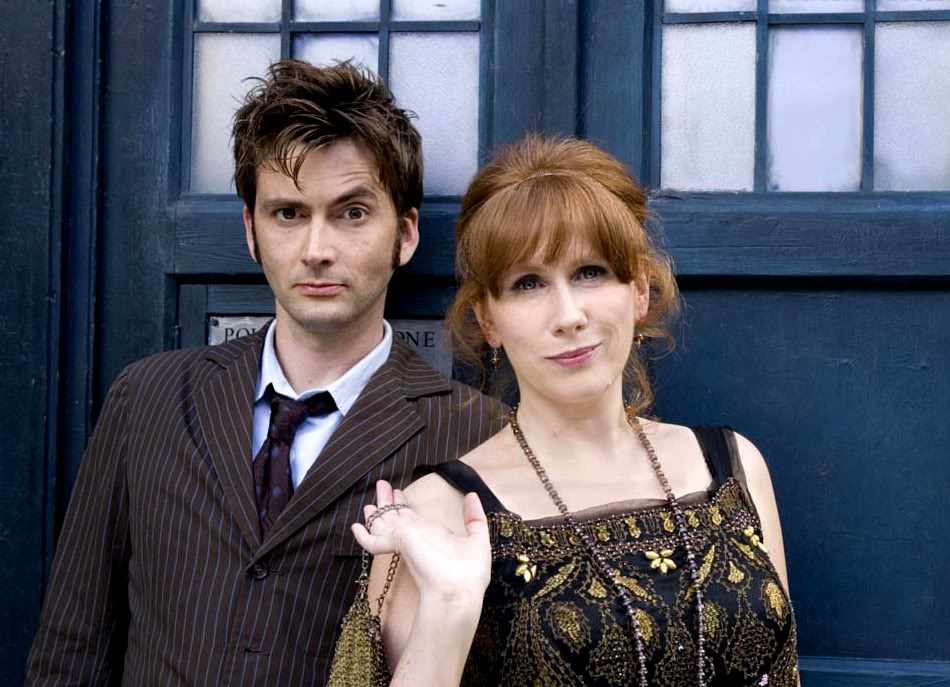
The Doctor and Donna are a decent TARDIS team.
Written between 29th April and 1st May 2013

Series Four is as mixed a bag as RTD ever gave us. Oscillating madly between stories that were technically brilliant and infuriatingly bad, you never really knew where you stood. The main ten stories of the season began well but ended up in a fanwanky mess, and the specials were very hit-and-miss despite their potential to bring the show out of its comfort zone. It will be remembered as the season of sensationalism, of silly prophecies, and of one of the most interesting companions in NuWho struck down in the cruellest way possible.
     Donna is a companion unique in the new series; she's the only one who's never flirted with The Doctor, and is thus the closest one to the Classic Companions. Her story is about a journey of self-discovery, a buildup of self-esteem from a Donna who was constantly put down by her mother and who became obsessed with trivialities at the expense of personal relationships into her Series Four self - the warm, compassionate woman who wants to travel and do derring do because she naturally cares for other people.I think her development was really well-done right up until the end, where her memory wiping was a complete cop-out that destroyed all my faith in RTD's Who.
      Speaking of that, this season does include several stories that broke my childhood innocence and helped me transition into my obsessive cynical teenager phase regarding the program, with stories like Planet of the Dead and The End of Time making me firmly Moffatian at the time. Most of the was mainly to do with the knowledge of Tennant's departure hanging over us and the 2009 hiatus, which we assumed to be a one-off at the time but which now seems to be far too common an occurance. When Series Four gets bad, it sits firmly in the lazily mediocre, with the vast majority of its bad stories failing due to a collapse into mushy fanwank. Let's have The Daleks go to Germany in a vain attempt to honour their conceptually Nazi roots; let's bring the Master back, no matter the silly lengths I have to go to do that. There's no thought behind it.
http://doctorwhocompanions.com/files/2011/03/wilfred-mott-bernard-cribbins-2.jpg
Wilf begins and ends the season.
     Bests and worsts. As is standard by this point. My favourite story from the season was the fun Fires of Pompeii, which mixed up sci-fi ideas with an exploration of our companion's conscience in a glorious Italian setting, with honourable mentions going to The Unicorn and the Wasp, which worked as a tribute to the works of Agatha Christie, and the Silence In The Library two-parter for its playfulness with the format. My least favourites... well, there are a few. Dishonourable mentions include The Doctor's Daughter, Midnight (don't lynch me, Fandom) and The End of Time, which despite being a massive Essay review still contains some So Bad It's Good charm. The worst story of the season by so many miles is the maelstrom of fanwank and misplaced nostalgia that was The Stolen Earth/Journey's End.
     The last season of RTD's era suffered a lot from what felt like RTD running out of ideas - or at least ways in which to execute them. It was clear that he had a lot of things he wanted to do with the series, but the way in which a lot of episodes were played up and sensationalised, almost in the manner of the tabloid press, distracted the series from actually telling good stories. The public perception improved, sure, and more than ever before the show was an event on a massive scale. But on an objective scale, Series Four veers between the brilliant and the mediocre in a way that I've never been able to keep up with.

Thanks.

Monday, 29 July 2013

Review: Doctor Who 4.16: The Waters of Mars

I guess we're here. The last aired episode of NuWho that I've yet to cover. It's really been fun looking over Ten's era again, and I think now that I've got a much clearer image of the way that he and his era were written. What went right and what went wrong. In a week or so I head back to 1975 to resume my runthrough of the Classic Series, but this is my last review of pre-broadcast NuWho. Here goes.

http://static.guim.co.uk/sys-images/Guardian/Pix/pictures/2009/11/11/1257966819535/DOCTOR-WHO---The-Waters-o-001.jpg
The Time Lord Victorius
Doctor Who - Season 30, Episode Sixteen - The Waters Of Mars
Written 27/4/13

Something rather wonderful about the specials is their variety. You would expect that five episodes written by the same person consecutively would have similar tones or ideas or levels of quality, but the span of episodes from The Next Doctor to The End of Time is instead frustratingly varied. After an okay Crimbo special and a lacklustre Easter special, this... 15th November special brought the quality up a notch and played with both old and new sci-fi ideas to create an awesome horror story.
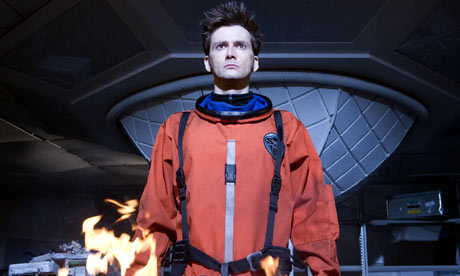
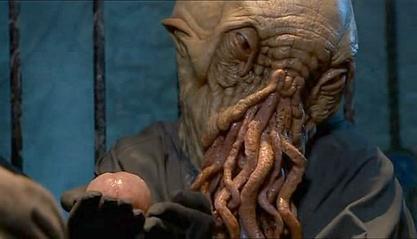
     The Doctor lands on Mars in 2059, where the first manned mission to the planet resides aboard Bowie Base One. The Doctor remembers that the base was destroyed by a nuclear explosion on the day he arrived, and that the death of leader Adelaide Brooke is a fixed point that inspired her daughter to be the first person to break the light barrier. Despite this, he can't stop himself from helping when a parasitic agent called The Flood arises from the team's Martian water supply, turning any member of the crew infected into water-spewing monsters. Enough crew members become infected to warrant exploding the base, but the Doctor is pissy about both being told he was gonna die last week and that Adelaide has to go too. He rescues three members of the crew, including Adelaide, and pronounces himself the Time Lord Victorius, ruler of all time. Just to put him in his place, she commits suicide. That showed him. The Ood call him off to the finale and the rest is history.
     The Doctor's attitude here as he wrestles with the fixed point is one that only really works within the context of the episode. In the Classic Series, given a few exceptions, The Doctor went around changing time willy nilly, and then after this in the Moffat era it's shown that preventing a fixed point makes all sorts of wibbly wobbly things happen. Doctor Who's core inconsistency catching up, I suppose. Given that Ten is already a bit of an anti-hero in terms of his stark arrogance and common selfishness, seeing him attempting to bend time itself to his will was simply an emphasised version of his regular personality, with that anger and confusion bubbling up to the surface. It feels like an acknowledgement of those traits by RTD, and the way that it's handled is brilliant.
http://www.bbc.co.uk/doctorwho/medialibrary/images/main-promo/the_waters_of_mars_the_story_so_far_1.jpg
The Flood infectees are brilliantly executed.
     Lindsey Duncan's Adelaide Brooke is an interesting temp companion, with a funky backstory and a temperment that made sure Ten was put in his place. I think that her being spared by the Daleks as a child due to her future importance was a little silly, especially as the Daleks were trying eradicate the Multiverse and so one child and her future shouldn't really matter. I also thought her "sacrifice" at the end, however nifty from a Time-travel standpoint, was completely out of character and quite frankly shocking. It's a continuation of a glorification of suicide that pops its head up now and then in the RTD era and it's really not a good thing.
     As a prefinale, The Waters of Mars shoves RTD's era into burgeoning new territory, and had the ideas set forth in this episode been followed up on I do get the feeling that The End of Time would be a much better set of episodes. There's a skill and an attention to detail in some of the aspects of Ten's "fall from grace" that ensure that The Waters of Mars stands out as the best of the Specials year. It's been fun reviewing Ten, but this is where it has to end. Ta ra.

Thanks.
    

Monday, 22 July 2013

Review: Doctor Who 4.15: Planet of the Dead

http://www.bbc.co.uk/doctorwho/medialibrary/s0/images/800/s0_06_wal_23.jpg?size=800&promo=/doctorwho/medialibrary/s0/images/main-promo/s0_06_wal_23.jpg&purpose=Computer%20wallpaper&summary=Sitting%20down%20on%20the%20job.&info=&tag_file_id=s0_06_wal_23
Hipsterrrrrrs.
Doctor Who - Season 30, Episode Fifteen - Planet of the Dead
Written 26/4/13

I was in Wales on the Easter of '09. I was still recovering from the fact that for the first year since 2005, we weren't gonna have a full series of Doctor Who on our TV screens. I really didn't need my one small consolation prize to be Planet of the Dead, a story executed so haphazardly at such a cost that I'd rather they hadn't bothered at all. Seriously, the expense that went into making this thing just went completely to waste, and it's nothing to do with the acting or the design - it's just a mediocre script that translates to a mediocre episode.
     The Doctor ends up on a bus with the world's thickest art theif Lady Christina (Michelle Ryan) as the bus pops through a wormhole onto a desert planet. Stuck and needing the bus to get through the wormhole, they try to organise their way out, with UNIT assembling on the terrestrial side. The Doc calls through to UNIT and talks to scientific advisor Malcolm (Lee Evans) who scans the wormhole, while Doc and Christina run into some fly people, who reveal that they arrived to trade with the planet, which used to be flourishing before it was devoured by a race of wormhole-making metal stingrays. They get back through by turning the bus into a hovercar, the stingrays get fried and The Doctor allows a career criminal to escape.
     We'd already had the first of our temporary companions in Jackson Lake, but as the first of the 2009 companions, Lady Christina de Suza doesn't really measure up. She's probably one of the least likable companions of the new series - I think I even prefer Adam Mitchell. Being a criminal is one thing - there's always the whole "steal to survive" motive to iron that out morally. But Christina is a fricking aristocrat, and she's stealing because she's bored. No amount of lax flirting will allow me to like a member of the corrupt aristocracy, especially with the current government. The hokey dialogue doesn't help either.
http://1.bp.blogspot.com/_yKAxZm9Y_wg/ScTWAsCMtMI/AAAAAAAADFk/FoihXMaTodI/s400/PlanetOfTheDeadPromos-0015.jpg
Thankfully the last of the animal-themed aliens of RTD's tenure.
     The idea behind the plot was okay, with the Dubai location looking absolutely smashing, and the damage the bus obtained during shipping being nicely worked into the plot at the last second. I wasn't a big fan of Malcolm; the character himself was harmless, but I wasn't really wowwed by Lee Evans in this role or in his stand-up, which consists of screaming vulgarities and making absurd noises as substitute for any wit or talent. I think that if that's RTD's idea of decent comedy then it explains rather a lot of things about some of his earlier scripts.
     There's nothing particularly offensive about Planet of the Dead on its own; it passes by with a few lumps of stupidity stuck to the plot, and by the end it feels little more than a light-hearted Easter romp. Which I suppose is what it was aiming for, really. But when your plot is one that shows us world-devouring aliens, a civilisation reduced to dust and a dumb-ass prophecy predicting The Doctor's death, you'd want it to feel a little more serious than the antics of Malcolm and Lady de Suza ever allow it to be.

Thanks.

Monday, 15 July 2013

Review: Doctor Who 4.12/13: The Stolen Earth/Journey's End

http://tvmedia.ign.com/tv/image/article/895/895510/the-stolen-earth-20080801011855745.jpg
Davros sounds a lot like that Circus guy...
Doctor Who - Season 30, Episodes Twelve and Thirteen - The Stolen Earth/Journey's End
Written 23/4/13

I'm gonna get this out of the way quickly. This two parter is one that I have a whole bucketload of contempt for, and unlike The End of Time, I don't even have the kind of grudging respect for it earnt over time and battles hard fought. As far as I'm concerned, this is one of the worst season finales that the show has ever done. Maybe not fundamentally, catastrophically bad by itself, but as a matter of opinion I just find it to be complete and utter tosh. And, with that in mind, we can begin.
     RTD had already informed Moffat of his decision, and while the public remained unawares we did get a small clue when this finale had cameos that basically summarised the entire RTD era to date. Fresh from the first series of Sarah Jane Adventures and the second series of Torchwood, Rusty incorporated his spinoffs into the main show, as well as bringing back all of his past companions save Adam Mitchell and giving us our fourth finale return with Julian Bleach's stab at Davros. It was, at the time, a fan's wet dream. To me, right here, right now, it feels a lot more like a bad fan-fiction, with the expected level of coherancy.
     Let's not bother with the semantics - let's get to the beefy issues. After a moderately coherant first half, disappointingly not-epic Shadow Proclamation and irritating attempts by Rose to be badass aside, we reach the pinacle of our story, where our thoroughly deified lovers finally meet, and Rusty gets a twitch and decides to cash it in on the ratings by pulling a joke regeneration sequence. I wasn't just shocked, I was pissed. It's one thing pulling that shit back in 1984, but this is the Noughties, the tabloid press sticks their nose into every nook and cranny. We knew there wasn't going to be a proper regeneration, so all it amounted to was unnecessary hysterics. This is Doctor Who, Rusty. You don't abuse the tradition of Regeneration like that, he doesn't get to frivolously pop one out when he feels like it.
http://suuuz.files.wordpress.com/2012/08/4x12-the-stolen-earth-screencaps-doctor-rose-badwolf-tenth-rose-3543632-624-352.jpg
"I tried being a Call Girl for a while, didn't work out."
     And that of course leads on to the horrendous 10.5. But we'll leave that for now, that's gonna come later, no, we've gotta talk about the whole Children of Time thing. See, mad Dalek Caan from New York popped back into the Time War (idk how, it's never explained) and came out a little worse-for-wear, but with a Dalek cruiser strapped to his jacksy. Ever since he's been prattling about the Doctor, his return and the way that he turns his companions into weapons, which is adequately displayed through the use of two magical Macguffins which his companions use to threaten the Daleks, including the Osterhagen Key (a German invention, featuring a perception of Germany straight out of Cold War propaganda with actual German language that's as shoddy as you can really get). The Osterhagen Key is a worldwide suicide bomb that destroys the planet when two people turn a key somewhere. Cos that's clever.
     Threatening the Daleks leads onto Davros' little tyrannical speech against The Doctor, telling him about how really he's a total douchebag, uh huh, and that ending the Time War and having such violent companions is totally the same as destroying everything in reality and he should totally feel bad about it. Sorry, not buying it - despite the lovely teary montage of every almost every guest character who's died since The End Of The World, The Doctor doesn't really have much of a role in their deaths. That's why it's a heroic sacrifice, it happens anyway, and it's to save lotsa people instead of just him, this isn't some kind of Doctor Who fan club in space who are jumping in front of buses and then saying he inspired them to do it. I'm all for talking down the Doctor, especially when we have the most deified Doctor ever surrounded by his cringey girlfriend and his supercute companions, but this just wasn't the way to go.
http://blogs.discovermagazine.com/badastronomy/files/2008/07/doctorwho_donna.jpg
Ta-ra, pet.
     Did I just call Ten.5 "supercute"? Probably. The creation of a human clone from The Doctor's severed hand thanks to a single touch to the glass of the casing by Donna was the point in 2008 where I began to question my devotion to the show that I'd followed like a religion for several years. It was too whack for me to jack. While duplicates would later become rather sickeningly common in the Moffat era, in the RTD Era it still stunk of the lowest kind of sci-fi silliness, and reduced the finalé to this otherwise okay series into soap opera mush. The ending, where the human Ten is banished from this world for the genocide of the Daleks (i.e. destroying the hateful killing machines whose only continual purpose is to destroy the universe) and then used as a human sex toy for Rose to bonk until she dies just cemented what a ridiculous turn of events had just transpired. (I apologise if that came out a little crass, I'm looking into it.)
     Plus, it meant that what happened to Donna actually, you know, happened. Just like in Doomsday, Rusty spent the whole episode repeating that someone was gonna die, and then he chickened out at the last second and instead of dying we just had Donna's memory wiped. This wasn't some great avant-garde decision, or some striking dramatic blow. It was an attempt at tragedy, sure, but instead of empathy I just felt wronged. Donna's entire character, her entire damn story, was about the transformation from someone who focussed on the trivial into someone acutely aware of her own being and self-importance. A woman who screamed at the world finally hearing it echo back. To erase her memories is to defile Donna's character, to stain the memory of what was one of the best companions of NuWho for the sole reason that she was the only female companion who hasn't at one time wanted to bonk him.
http://img.gawkerassets.com/img/17mtr3x3n4m0qjpg/ku-xlarge.jpg
The point in Friends where the audience gasps.
     I often find myself comparing this finale to Dimension In Time, and the comparisons are, I feel, warranted. It's all very well and good having a massive cross-over, and it's a fun thing in general. But if your mechanism for doing that creates a script with such stupid leaps in logic and really abuse of what the show stands for, then you change your script and you cull the strays. As a last outing for our continuous Who series, following a consistent run over four years, it was a fittingly epic finale, but in acheiving that atmosphere it sacrificed common sense. The following year would see the four specials, the end of RTD's tenure, the series of Torchwood that never was, and the transition to the current showrunner. This isn't quite the end of my RTD reviewing, but it's damn close.

Thanks.

NEXT WEEK: The audience wishes they could have been on the Planet of the Dead!

Monday, 8 July 2013

Review: Doctor Who 4.11: Turn Left

http://www.bbc.co.uk/doctorwho/medialibrary/images/misc/greatest/viewers_greatest_05d.jpg
Hmm. New teeth. That's weird.
Doctor Who - Season 30, Episode Eleven - Turn Left
Written 20/4/13

Ooh. This is awkward. For those of you who don't read my reviews very often (or at least weren't reading a few months ago) you may not know that I'm not the world's biggest Rose fan. I've already written my fingers off about her character in her original run, but this run of three episodes marks the culmination of a series of silly hints and references to her return. Rose has been bigged up beyond comprehension by this point, you understand. And it's only gonna get worse.
     Turn Left is an episode that exploits a great deal of NuWho mythology, taking an event from The Runaway Bride and spinning it off into a parallel universe where for whatever reason the Doctor died, leading to misery and death for everyone. It's part of RTD's Doctor deification scheme that's been running for quite a while now, and while the use of alternate realities is fun, a lot of the changes end up being extraordinarily contrived.
     The episode proposes that if the Doctor died in The Runaway Bride (from drowning, apparently, because losing Rose is enough to send him into a fucking suicidal fervour), then the present-day stories from Series Three and Series Four would all have gone terribly wrong. Sarah Jane, her troupe and Martha Jones die when the Judoon steal the Royal Hope Hospital. Adipose Industries decimate the Americas (why didn't they do that in our reality?). The USS Titanic crashes into London and has the same effect as a nuclear bomb, wiping out the South of England (despite the episode telling us that such an explosion would destroy the planet). Torchwood dies and Jack is inprisoned on Sontar when the Sontarans invade. The episode is presented from the eyes of an affected Donna, who is guided by a dimension-jumping Rose, who helps her set the timeline right.
http://angerbanjo.files.wordpress.com/2010/12/turn_left_promo10.jpg
Donna's life goes in a different, more depressing, direction.
     Seeing Donna reverted to her obnoxious pre-Doctor personality wasn't a fun experience, and considering what's gonna happen in a couple of weeks it's almost desperately tragic. Seeing her try to survive while the world goes to shit made the episode one of the most depressing since the ending of The Caves of Androzani. For me it never felt believable, because the events that occur are so arbitrarily put together. If Sarah Jane wasn't at the hospital in the main timeline, why was she there in this one? If Donna was able to go it alone inside the Sontaran ship, why would Gwen and Ianto be killed? And why didn't the Titanic wipe out the planet?
     Meanwhile, Rose's return isn't as bad as it could be, because The Doctor is nowhere to be found. Her character is nothing like it was before, and she's now a generic badass action girl whose actions are still dictated by her obsessive attempts to reunite herself with The Doctor. Even when he warned her that breaking the barriers of reality would fuck shit up, and even though time travels much faster in her parallel universe (it's been two years for The Doc and about six or seven for her), she went and did it anyway. Bleh.
     I appareciate that Turn Left was trying to use Alternate Realities, which is a sci-fi theme that when used correctly is damn-awesome. But the way it was executed was drenched in inconsistency and ties so much into RTD's fluffyness that I can't appreciate it as much as I'd like to. And because I really do doubt that the UK Government would start putting the Italians into concentration camps if London was destroyed. See you next time.

Thanks.

NEXT WEEK: Mighty Massive Crossover Bullshit! It's The Stolen Earth/Journey's End.

Monday, 1 July 2013

Review: Doctor Who 4.10: Midnight

http://images4.wikia.nocookie.net/__cb20080625193042/tardis/images/e/e3/Sacrifice.JPG
Why make a tourist attraction on a planet where the smallest
accident kills everyone instantly?
Doctor Who - Season 30, Episode Ten - Midnight
Written 14/4/13

C'est le début de la fin, mes amis. This deliberately Companion-lite episode begins a string of episodes written by and marking the end of the tenure of Russell T Davies as the show's producer. Midnight is often heralded amongst even his haters as that one time that Ol' Rusty did good - a pretty decent episode, all in all, and scarier than even Moffats concoctions. And, while I see where much of that praise comes from, I have to play Devil's advocate on this one and say that while it may be decent technically, it's not very fun to watch. It's an opinion I've never really had before - I can see how great it is, but I'm just not really a fan.
     With Donna sunbathing, The Doctor goes off on an excursion over the diamond planet Midnight, trapped in a sealed tourbus with a working-class family (including Colin Morgan before he was Merlin), a Professor (David Troughton!) and his assistant, and the recent divorcee Sky Silvestri (Lesley Sharp). While travelling, their vehicle mysteriously stops, and Sky is possessed by an unseen creature that begins repeating everything everyone says. After latching onto The Doctor and beginning to say his words before he does, the group become convinced that The Doctor is now possessed, and he is nearly thrown out into the radiation outside. Luckily the day is saved by a noble sacrifice.
     The gimmick (feels like a negative word, should use it less) of the so-called "Midnight Entity" and its ability to steal someone's voice through repetition and learning evokes something from the Wilderness Years in terms of ambition. This isn't a monster that you have to characterise or world-build; rather it's something more distinctly alien, and exploitative of the personalities around it. For me, that idea is cool. The execution of that idea... meh. Lesley Sharp gives it a damn good go but while some may find repetition and hammy acting scary in this instance, I am reminded a little more of children's comedies.
http://www.scifiheaven.net/wp-content/uploads/2008/06/s4-10-wal-06.jpg
Merlin, tired of waiting for Arthur to reawaken, goes through
a goth phase and pretends to be a family's son.
     The same is true of the episode's other main selling point - a thorough and vicious dressing down of all of humanty's paranoid tendencies. The mob mentality amongst the passengers of the shuttle as they react in fear of first the creature inhabiting Sky and then later of The Doctor, is quite clear and direct and indeed feels rather realistic given the circumstances. The Doctor's usual schtick doesn't work, because the tight surroundings mean that everyone looks through his charming exterior very quickly, and he ends up becoming the prime suspect of their accusations because of it. But just because it's wonderfully realistic does not for me make it something I particularly want to watch - I have the small hope that I would not react as such in that situation, and thus I just get very annoyed at the variety of personalities who end up acting like complete and total whazzocks.
     So yeah. Midnight is very well put together, I'll give you that, but it's a matter of perspective, and while to some Midnight is a wonderful modern art piece with lots to say about the dark nature of humanity in the face of fear, I find that any artistic intent gets mopped up by hammy acting, annoying characterisations and the feeling that nothing is really happening. The Doctor went on a trip where some humans went crazy and tried to kill him, wow. Doctor Who at it's best, I'm sure, ha ha. Sorry, that was a little too sarcastic. Anyway, just not my cup of tea, and that's that.

Thanks.

Monday, 24 June 2013

Review: Doctor Who 4.8/9: Silence In The Library and Forest of the Dead

Doctor Who - Season 30, Episodes Eight and Nine - Silence In The Library and Forest of the Dead
Written between 5th and 12th April 2013 (With touchups on the 23rd June 2013).

Is it really that time again? Seems only yesterday that I reviewed Blink and was rather harsh about it. No such luck here, though, as we enter into a story that is both breathtakingly brilliant and rather desperately forboding of the things that'd come after RTD left. It was half-way through writing this story that one Steven Moffat discovered that he was to be the next producer, and that has had a profound effect upon the story's content. Mainly due to the first and chronologically last appearance of one River Song, Moffat's favourite pet character who, as we know, would go on to appear until the end of the most recent season.
http://images2.wikia.nocookie.net/__cb20110814133111/tardis/images/9/97/Silence-in-the-library.jpg     To be fair though, River Song's portrayal in this episode is one that ends up taking a much stronger, more tragic tone. Instead of being the bolshy, Doctor-dependant psychopath she would later be revealed as, the oldest Professor Song is much more reserved and rather saddened at the fact that her lover doesn't recognise her face (and likely never will again.) Alex Kingston balances the character between the danger at hand and the greater mystery of who the hell she is very well, and the performance blends seamlessly with her next few appearances in the show. In fact, one could say that her performance is so good that it spoils you for the rest of her tenure, especially as here the whole "spoilers" routine feels fresh and weird and mystical and the fatigue that comes from its constant repetition has yet to rear its ugly head.
      The story's main villain, as is standard by now for The Moff, is the spookification of a mundane fear - this time the fear of the dark, as extrapolated into clouds of carnivorous micro-organisms that can only live in the dark that strip flesh to the bone. It's a cool idea, and is instant paranoia fuel - especially as Moffat has Ten mention that the "Vashta Narada" live on Earth too. I liked that the Doc didn't find a way to magically destroy them all, either, but rather had to negotiate with them to allow him to evacuate everyone from the Library. There's far too little simply negotiating with villains these days, especially in the Moffat Era where a villain is more likely to be taken out by a magnificent end-of-episode explosion for little-to-no reason.
     The main, rather Moffattian subplot of Donna being uploaded into a massive computer where she slowly realised that her life was a fake, was incredibly clever, and made use of a lot of tropes that I don't think I've seen before played straight. (Donna being unable to remember what happens between jump cuts, for example.) The way that the subplot inside the computer ran alongside the events in the Library worked well as a mystery, and although as a child I worked out what was going on rather quickly, it's still a neat mystery to go along with.
http://tvmedia.ign.com/tv/image/article/883/883689/silence-in-the-library-20080623061406163.jpg     If there are any problems, they do arrive in the character of Miss Evangelista, played by St. Trinians starlet Talulah Riley, where some of the things that many claim to be omnipresent in the Moffat Era take a firm foothold. The entire point of her character seems to be to shift from a beautiful ditz outside the computer to being a hideous genius inside, implying that a woman is incapable of being beautiful and intelligent at the same time and that her non-attractiveness is somehow a handicap to her continuing function. It's probably a niggle, but Miss Evangelista's use as the tragic figure so underestimated by her fellow collegues is put into sharp contrast when she ends up going on profound rants about the nature of beauty and intelligence which highlight the bumpiness in Moffat's attitudes.
     As an execution of the River Song concept, the episode manages to do it all in a nutshell, and I would have been perfectly happy if she had been left in this story and her future adventures with The Doctor been left as a Valeyard-esque mystery. Outside of that, the rest of the episode's core concepts are just really well done, even if I disagree with the way that one of the minor characters is portrayed. The joy of this story is that despite my problems with its writer and the eventual fate of its star guest character, I really struggled to find fault with this two-parter. And that's got to mean something, eh?

Thanks.

Monday, 17 June 2013

Review: Doctor Who 4.7: The Unicorn And The Wasp

http://tvmedia.ign.com/tv/image/article/882/882162/the-unicorn-and-the-wasp-20080617053227843.jpg
Agatha Christie (Fenella Woolgar) helps the Doc solve a
murder case.
Doctor Who - Season 30, Episode Seven - The Unicorn and the Wasp
Written 1/4/12

Wowzers. While at times feeling a little out of sorts, this often criticised episode is an episode that is both irreverantly fun and fairly cultured at the same time, following the trend of the historical guest star with an appearance by a decent approximation of Agatha Christie and, like previous writers featured in NuWho, the story has been tailored to mimic and parody their works. Aside from a few issues with pacing, I think it's pretty good.
     The Doctor and Donna arrive at a 1920s dinner party on the day that Agatha Christie disappeared before reappearing a month later under another name. While not prying too much into the circumstances of that, they become embroiled in a mystery to find the killer of several people, including Professor Peach (a nod to the Christie-inspired Cluedo), the indian housekeeper Mrs. Chandrakala and the closeted aristocrat Roger. It is revealed that one of the members of the party is a Vespiform - a humanoid capable of transforming into a giant wasp, with telepathic powers linked to the Lady's jewel, and a result of her teenage affair with an alien in India. After much deduction, the killer is revealed to be the quiet Reverand Golightly, who has been playing out his murders like an Agatha Christie novel due to his mother's fondness for the books.
     The incorporation of references, both to Christie novels, plots, names and history gave the episode an almost Gattissian level of historical tone and, while it eres closer to the more poplised version of Christie's novels, it does feel like something of a tribute to her as both a woman and as a writer. Fenella Woolgar shows a woman blessed with an intuition and intelligence that allows her to understand motivations and thought processes, but with a frustration coming from her inability to apply it to her own personal life. Maybe not accurate to the real Christie, but a compelling character nonetheless that really stands out in the guest cast. (Which happens to include Felicity Kendal, being significantly more low-key than I'd expect.)
http://www.bbc.co.uk/doctorwho/medialibrary/images/main-promo/s4_07_ps_02.jpg
Three guesses as to which of the lively ensemble is the villain.
     The comparisons must be made, of course, to similar interbellum stories in the show's history. Like its Eighties predecessor Black Orchid, the story attempts a cohesive murder mystery, but it all goes a little too fast to work. There's a reason why Morse and Marple and the like end up going on for three hours with seventeen different ad breaks where they try to sell you various brands of expensive tea - it's about drawing the mystery out so that the viewer has the chance to pick a favourite, and pick a villain, and try and work it out from there. I know Doctor Who is a bit wham-bam-shebang in this period and we are talking about a comedic 45 minute tea-time adventure, but if you're going to make a tribute to murder mystery it would help if the villain isn't obvious within the first ten minutes.
     Other than that, I think that it all worked well. For something that was focussed more on a mid-season comedic angle, I thought that the main story and the character work behind it were surprisingly strong, and despite how out-of-the-blue the eventual solution comes, it is fascinating and amusingly appropriate for the genre. It makes me wish that there were more stories set in the 20th Century, and especially around this time period. Or maybe it just makes me want to watch Jeeves and Wooster again; either is fine. Any episode that can inspire that is good in my book, for sure.

Thanks.

NEXT WEEK: She's here! Batten down the hatches, seal off the windows. Moffat is about to be told that he's the next head writer half-way through writing a story, and the result will change the show for the next half a decade. It's the first appearance of River Song in Silence In The Library/The Forest Of The Dead.

Monday, 10 June 2013

Review: Doctor Who 4.6: The Doctor's Daughter

http://tvmedia.ign.com/tv/image/article/880/880182/the-doctors-daughter-20080609043158269.jpg
The Doctor's Daughter who played The Doctor's Daughter
in The Doctor's Daughter and then had The Doctor's Daughter.
Doctor Who - Season 30, Episode Six - The Doctor's Daughter
Written between 30th and 31st March 2013

We had a good run of gushing, I suppose. But for me this era of Doctor Who is very hit and miss, so you shouldn't really be very surprised. Especially when it comes to The Doctor's Daughter, which is an episode so steeped in problems that it's practically wading in them. As usual, it's not the total shitstorm that the typically hyperbolic fandom would have you believe, but at the same time it doesn't come away smelling of roses. (Look I made a reference.)
     The Tardis crew are swept away by the sentient machine, which drops them on the planet Messaline, the sight of an everlasting war on a subterranean world between humans and the fish-like Hath. There, The Doctor's DNA is used to make an easy-grow soldier called Jenny (Georgia Moffet, who got together with Tennant while making this episode. Aww.) and he has some paternal issues to get over when he discovers that she's a Time Lady. Separated, Martha and the rest of the gang make their way to the Temple, where they work out that the war has only lasted seven days and that the myths arose due to the easy-grow solider machines pumping out generations of clones. Jenny gets shot and The Doctor makes an egotistical speech, but thanks to Moffat meddling she revives later on, disappearing off into the sunset.
      I'll say now that there are a few ideas that I rather like in The Doctor's Daughter - the seven day war arising out of inappropriate use of cloning technology is rather clever, and is a decent extension of sci-fi ideas. It is a little shot by the character of General Cobb; all the clones we see are fresh and young, whereas Cobb sprouts all the myths despite looking like an old-timer. I personally like the theory that Cobb was always a nutjob, and that the seven-day war was just the perfect opportunity for him to kill some people.
http://1.bp.blogspot.com/-EWa7l0f2Uek/UO3ciAgo-mI/AAAAAAAAHvI/7XF-iYhsbpQ/s1600/6.jpg
Where the fun sci-fi breaks down into rubbish.
     The episode is guilty of what I would call over-sensationalism. There are often remarks made by fandom pertaining to the idea that RTD tended to appeal more to the tabloid press during his final series, and this episode seems to be this on a plate. A title like "The Doctor's Daughter" is meant only to get fans excited to see Susan's mother or something deeper in the show's mythology. Instead we got a silly story about a sexy clone and a war with the fish people.
     Whereas the three episodes of Torchwood that saw Martha's return were three of the best of that series, these three in the parent show have been less than so. And on that front, it was because Martha was criminally underused and consistently kept out of the action, making me wonder why she was brought back in the first place when it obviously effed up some of the contracting. The Doctor's Daughter promised so much, but it ended up giving us so little.

Thanks.

NEXT TIME: Agatha Christie fun in The Unicorn and the Wasp.

Monday, 3 June 2013

Review: Doctor Who 4.4-5: The Sontaran Stratagem/The Poison Sky

http://i301.photobucket.com/albums/nn41/sue_denimme/The_Sontaran_Stratagem_402.jpgDoctor Who - Season 30, Episodes Four and Five - The Sontaran Stratagem and The Poison Sky
Written between 25th and 30th March 2013

Helen Raynor, the woman who brought us Dalek mutants with penises on their faces, delivers another early-season two-parter that begins a trilogy of episodes featuring the temporary return of my favourite RTD companion, Martha Jones. It also follows a NuWho trend of reintroducing one Classic Monster per season, this time reinventing the war-like Sontarans into much shorter, modern versions with a penchant for the colour blue and rugby chanting.
     I want to like the story; I really do. It's the first UNIT story for 19 years, it reinvents the Sontarans in a way that's half-decent, and it sees Martha' return. However, it also has a great number of elements that I find less appetising. The main one is the Sontaran redesign - not aesthetically, but in their attitudes. It's almost as if they're overcompensating - every element of their personality, of their backstory, is ramped up to its logical maximum and the result is a story whose villains fail to feel intimidating. I mean, invading the Earth and turning it into a hatchery? It just doesn't feel very Sontaran.
     That and the few other elements that irk me. Sorry to be so overly negative, but I need to get them out of the way. First we have annoying American mega-genius Luke Rattigan (Ryan Sampson) who spends the entire story acting like a spoilt child in the most annoying ways, with a "twist" resolution where he settles a petty score by blowing up the Sontaran ship. Then there's the attempt at an environmental message, which is shoehorned in and feels totally confused. Then there's the clone subplot - clone subplots are always silly, and this one was even worse for the fact that it went nowhere.
http://images3.wikia.nocookie.net/__cb20100619132106/tardis/images/1/13/Sontaranstrategem.png
Although I do like the NuWho Sontaran design.
     So yeah, it didn't really work for me on the plot levels. More mediocre than outwardly bad, I suppose. What startled me was The Doctor's personality, which has gained a much more dickish undertone. I'm probably just reacting to him going back to normal after a season of being cautious around Martha, but in this episode both his stark egotism and his hypocrisy around guns came to a fore. His dismissal of the UNIT soldiers and his willingness to stand by as they were massacred, blaming their deaths on their own incompetence, made me feel rather unsettled.
     The Sontaran two-parter is fatally uninspired, and its mishmash of plot elements is not redeemed by a couple of good lines here or there. I suppose it could be standard Who fare if viewed on a surface level, but otherwise it is steeped in a quiet mediocrity underlined by a lot of ugliness on the part of The Doctor's characterisation. It is such a shame that Helen Raynor's Who work isn't as strong as her work on Torchwood, and that this, her last story to date (and the last Who story to be written by a woman to date) is so offensively bland.

Thanks.

NEXT WEEK: Sensationalist titles and terrible scriptwriting in The Doctor's Daughter.

Monday, 27 May 2013

Review: Doctor Who 4.3: Planet of the Ood

http://upload.wikimedia.org/wikipedia/en/9/93/Planet_of_the_Ood.jpg
A natural-born ood has two brains.
Doctor Who - Season 30, Episode Three - Planet of the Ood
Written 23/3/13

For reasons that are yet to be discovered, the Ood have become something of an RTD posterboy, in much the same way that the Weeping Angels are for Moffat. There's something about their distinctive design that manages to jump so quickly between humour and sheer horror that makes them strangely endearing, as well as their sheer alienness. Planet of the Ood takes a concept that was only touched upon in their first appearance and spins it wide, creating an episode that manages to be both intellectually deep but aesthetically breezy.
     The Doctor and Donna arrive on the Ood Sphere, the Ood's home planet where the creatures are grown and processed by Ood Operations and then sent out to the three corners of the Earth's trigalactic empire. The facility has seen Ood go rogue, succumbing to a condition called Red Eye which makes them either murderous or simply rabid. As The Doctor and Donna investigate the facility, they are shocked to find that the Ood were not, as they were told, born to serve - they are in fact partially lobotomised, with their telepathic ability severely limited by a dampening field on their hind brain. Thanks to a patient Ood Sigma, the facility head Mr. Halpen (Tim McInnery, Blackadder) is made docile by being turned into an Ood, allowing The Doctor to turn off the dampening field and free Oodkind.
     I liked the way that even The Doctor highlighted the rather dangerous way that the Ood have often been treated as something laugh about, especially with Doctor Who's long history of abhorring slavery of all kinds in all circumstances. The most recent example of this was in Chris Chiball's (who else?) ridiculous Pond Life prequels to Series Seven, where the Ponds treated an Ood like a slave for several weeks. Sorry, getting off topic. The way that the Ood's history was explained in such a thorough and touching way makes them one of the more interesting of the races introduced by RTD's tenure.
http://media.screened.com/uploads/0/4335/292253-dw_4x03_planet_of_the_ood_853.jpg
The Hokey Kokey is one of the Ood Sphere's most popular games.
     The episode's vibe felt very Star Trek to me - not, of course, that that was a bad thing. Moral dilemma about aliens in slavery, humans looking like the bad guys - it's all there. The episode managed to maintain that strain of moral discourse for the vast majority of the story, but the only problems came when that had to be supplemented in with action, adventure and plot. The scene where The Doctor is chased around a warehouse by a crane controlled by a guy who's gurning for his life, and the end scene where Tim McInnery peels his head back and coughs up tentacles... none of it matches up with the rest of the episode's sharp messages. Instead of it being just about the evils of dehumanisation and slavery, it had to include guys who were just doing for da evuls.
     So, yeah. Planet of the Ood has a lot of emotional and intellectual complexity in its messages, and it presents the plight of a previously underdeveloped alien race with a great deal of humanity. But it manages to lose a lot of that complexity in its attempts to appeal to the wider demographic, and a lot of moments seem out of place because of it. But really, it's amazing that the ideas were given this amount of depth at all - as such, Planet of the Ood becomes something much more special: a pleasant surprise.

Thanks.

NEXT WEEK: Martha's back, and so is an old enemy - Phil Mitchell! Wait, sorry, my mistake. We face the Sontarans in The Sontaran Stratagem / The Poison Sky.

Monday, 20 May 2013

Review: Doctor Who 4.2: The Fires of Pompeii

http://images3.wikia.nocookie.net/__cb20110509071506/tardis/images/6/6b/Vesuvius_Erupts.jpg
I suppose you could say that this episode gets quite explosive.
Doctor Who - Season 30, Episode Two - The Fires of Pompeii
Written between 19th and 21th March 2013

I'll out with it. This is my favourite episode of the season, hands down. There's a combination of factors that make Fires so perfect - a good sense of humour, a few decent sci-fi ideas, and some awesome writing for our core characters that plays upon themes that haven't really been touched since the black and white era. Give The Aztecs a massive budget, some overseas location filming and a comic actress swiftly proving her critics wrong on every single count, and you come to some approximation of the epic that is The Fires of Pompeii.
      On her first trip out, Donna is taken to what The Doctor initially believes to be Rome in 79 AD, before the lack of any colliseums and one rather angry-looking volcano inform him of his titular location. Concerned due to the impending eruption, Donna wants to save everyone - but The Doctor is ardent against it, explaining that Pompeii is a fixed point in history. Travelling to the house of sculptor Caecillius (the amazing Peter Capaldi!), The Doctor discovers that the city is being controlled by the Seers, both the Sisterhood of the Sybilline and the more vicious Lucius Petrus Dextrous (a very devillish Phil Davis). Following paths of investigation, they find that people in the city are being slowly inhabited by alien dust, which turns them into the stone-like creatures called Pyroviles. Using their own power systems, The Doctor realises that the only way to stop the Pyrovile invasion is to explode Vesuvius. Despite still being unable to save everyone, Donna convinces him to save Caecillius' family, and he thanks her for doing so.
     The central conflict of the episode originates not from the Pyroviles (who are one of the coolest monster designs of the New Series, by the way) but from Donna's compassionate nature and the argument between fate and free will (albeit given semi-scientific justification). It's a demonstration from the off of Donna's incredible compassion, in the way that she forced The Doctor to relate to Caecillius' family and begged to the point of tears for him to consider saving anyone from the event. On the other side, and Ten was written in a way which felt similar to some of the more dickish parts of his persona, except with a decent justification that turned it into something quite fascinating.
https://blogger.googleusercontent.com/img/b/R29vZ2xl/AVvXsEhGGTzR-obMeStWirZnU9-xrzm9yDRZU1PQOHecyrtQtbNKXlHoZgykH7xY5lpJHGwQluCo7L08p2_1sw5buHJSi_PVF4mJBLLc_yFYSq-9nlTOhsfr1ZCbbLSXnK9knWlbfBjNRgTCmHh9/s1600/KarenGillan-FiresOfPompeii.jpg
If you put "The Fires of Pompeii" into Google, this is the
most common type of image, for the sole reason that this
happens to be future companion Karen Gillan.
     The rest of the episode's concepts and characterisations did however feel noticeably under-developed - the threat of invasion was never on the table for very long, and despite his badass boasts and grand proclamations, the threat of Lucius Petrus Dextrous never extends beyond a shouty man in a toga. The way Caecillius' family is written as if they come from Kent rather than Italy was used for quite a few good jokes and references, but the episode didn't really go for a realistic roman feel. Instead, it went for a more humourous (and albeit more enjoyable) route that mixed those modernised characterisations and scenarios in with historical and linguistic jokes.
     What results is an episode that perfectly balances the good and the cheesy, resulting in an experience that is enjoyable from start to finish. The location filming in an Italian studio looks absolutely stunning, and it's easily one of the best environments that NuWho has created. While it wasn't perfect, especially in some of the ways that sidecharacters were utilised, everything fell together and The Fires of Pompeii establishes itself instantly as a Doctor Who Classic.

Thanks.

NEXT WEEK: The Doctor Who aliens I almost forgot to mention when I reviewed their first appearance... we take a trip to the Planet of the Ood.

Monday, 13 May 2013

Review: Doctor Who 4.1: Partners In Crime

Doctor Who - Season 30, Episode One - Partners In Crime
Written between 16th and 17th March 2013

Of the three central companions of RTD's era, the one with the most developed characterisation is certainly Donna, with Martha (as you can probably tell from the ten weeks of gushing I did about her) is a very close second. Her introduction in 2006's Christmas special allows Partners In Crime a great deal of leeway, meaning that it doesn't have to do a lot of the legwork that character introductions usually do. Instead, it takes a developed Donna and puts her into a series with a new-found sense of humour that is at times both strange and wonderful.
Cute little bastards.
     Both Donna and The Doctor research into Adipose Industries, a popular weight-loss company who have been treating the problem with a "miracle pill" that they intend to roll out nationwide. Despite several near-run-ins, they both miss one another. Both independently discover that the pills bind the fat into tiny alien creatures that go walking away, and when they both stake out at the building the next day, they run into each other just as the villain Ms. Foster (Sarah Lancashire) is explaining her plan. The Doctor manages to foil Foster's plan to accelerate the production of the creatures (which would kill 1 million people) and watches as the Adipose parents take their children and drop Foster to her doom. As Donna readies to go away with the Doctor (making it clear that she's not going to be doing any of that romance nonsense) it's revealed that Rose has somehow returned.
     A lot of the press at the time focussed heavily on Billie Piper's last minute cameo, and at the time - when, I'll admit, I had a bit of a crush on her - I was amazed. However, taking a more critical view (yeah, ten NuWho reviews without much Rose bashing, must be a record), it stinks of sensationalism. Sometimes it's what people remember the episode for, when there was so much there to love besides that appearance. As I said back in my Doomsday review, Rose would become more and more bigged up by the show throughout the time she wasn't in it, and this is really the beginning of that final push towards her return and the royal mess that it created.
     Although, as I said, we've already met Donna, the episode does cue us in on her more domestic life. The mother-daughter relationship is interesting, similar to the Disappointed Father routine but with switched genders. We also get to see that Wilfred Mott from Voyage of the Damned is her grandfather, and it's great to have Bernard Cribbins in the show. Most importantly though, it's clear the Donna's characterisation has had an overhaul from when we first saw her - almost gone is the obnoxiously loud woman from the early parts of The Runaway Bride, and here we have a much more mature woman whose positive qualities (like constant inquisitiveness and unending compassion) are on clear display.
The Doctor and Donna's clearly platonic dynamic is a winner.
     Sarah Lancashire plays the villain with a suitable level of hamminess to make her enjoyable - especially when she's playing on the whole "crazy foster mother" thing. The Adipose threat isn't really all that huge on its own - the rate of production of the creatures actually allows the adipose to perhaps form a symbiotic relationship with humanity - we get to eat as much as we want and stay thin, while they get a billion new babies every evening. I suppose what Rusty was trying to do was to make some kind of commentary on modern obesity epidemics, but it led more to fat people being played for laughs rather than as a concept of aliens being able to capitalise the Western obsession with our weight.
     Playing things for laughs was noticeably more prominent in general, as we'll see across Donna's time on the show. It probably stems from Catherine Tate's comedic pedigree, but arguably her standard gawping routine has had to be toned down to make most of it work. It's that balance that creates a show that manages to provide the same level of well-written characterisations and interesting concepts while still being a great deal funnier and ultimately more irreverent. Partners In Crime is a great start to the new series and it feels, more than ever, that we're going to have a lot of fun.

Thanks.

NEXT WEEK: Karen Gillan, already? Oh wait, she's just a Roman woman. We look at timey-wimey Roman fun with The Fires of Pompeii.

Friday, 3 May 2013

Overview: Doctor Who: Series Three

http://infinitecoolness.com/stuff/posters/doctorwhoseason3firerunningposter.jpgWritten 15/3/13

The boring one. Or at least, that's what a lot of Whovians seem to remember it as. There's a combination of factors as to why the fandom so often dismisses a lot of Series Three, not many of which I can fully understand. It is true that the series has one or two stories that don't exactly push the boat out, but there's also a lot of subtle character development that the series prior to it had really lost. The main reason for that? Martha motherfucking Jones, that's the reason. She defines this season and with very good reason, because she is (at least in her own season) one of the most interesting and emotionally complex companions of the New Series.
     Like Rose, Martha's journey begins at a humdrum life. However, unlike the previous insistence that normal life is quite obviously a fate worse than death, Martha is actually going somewhere in the world - she's a medical student. Her reasons for travelling with the Doctor are therefore less about getting away from her life and her family (who are admittedly falling apart around her) but rather for the sheer adventure of it all. That, and because she's got one hell of a crush. So many people use the fact that her character is underscored by her crush on The Doctor as a mark against her, whereas I see something different - something that eminently fresh in Doctor Who at the time. Fandom aside, the Doctor has only had a few previous relationships in the show, and all were mutual. Just because this series asks the question, "What would happen if the companion had a crush on The Doctor?" doesn't mean that it's bad.
     The key here is Martha's development. She doesn't just stay love-sick and heartbroken forever. Through the last few stories, she spends the equivalent of about two years doing nought but supporting the Doctor, fighting for The Doctor, even putting up with a version of him being incredibly racist. The Doctor himself is dismissive of the role her race plays in their advenures, shrugging it off in The Shakespeare Code as analogous to his alienhood, despite said alienhood rendering him with the body of a while, cisgender male with a British accent. Martha suffers through a hell of a lot of shit, is what I'm basically saying, and in the end she chooses to leave because that's the right thing for her to do. Because she's grown up, maybe not from a girl to a woman, but through the subtle emotional maturation that we all have to go though in our lives.
http://media.tumblr.com/tumblr_m1vi4eHk511r8aaiv.jpg
Ok, so maybe I gush about Martha a little too much in this
article. But I gotta.
     Aside from Martha, the season does have a selection of very good stories. My favourites are probably going to be Gridlock, whose mixture of well-executed sci-fi and subtle characterisation won my heart, and the Family of Blood two-parter, where a deep-probing examination of The Doctor's persona was blended nicely with some firmly anti-war allegories. Something key for me is the presence of a clear arc, but not the kind we've been thrown by Moffat - one similar to the one in the first series, a subtle but omnipresent movement of characterisations.
     I've really enjoyed watching Series Three. In general there's been a greater number of stories that have proved better than I rememebered, and up until the end (with all of the crazy jesus stuff that just makes me cringe) it's interesting even in its most dull or silly moments. It introduced us to one of RTD's best characters and it was, in my opinion, the last season of the new show before everything got real crazy, real fast. While it wasn't the end for Martha (as we'll see in coming weeks), it introduced her, defined her, and gave her a real chance to shine.

Thanks.

Monday, 29 April 2013

Review: Doctor Who 3.12-13: The Sound of Drums and Last Of The Time Lords

http://images3.wikia.nocookie.net/__cb20110724110404/tardis/images/4/4b/The-sound-of-drums.jpg
The Master reacts to being called insane.
Doctor Who - Season 29, Episodes Twelve and Thirteen - The Sound of Drums and The Last of the Timelords
Written 10/3/13

Charting RTD's relative rise and fall in popularity, one of the first massive fan outcries at something in his reign was the Series Three finale, which was filled with some of the standard RTD moves but which made rather a lot of people think that he'd gone a step too far. While I don't really object to it a lot, I do admit that there are a couple of problems with RTD's writing here that return from his previous finales, and in a way which is much more gradiose and ridiculous. The build-up is great, but I've still yet to see RTD ever deliver a truly satisfying conclusion to a story.
     Using Jack's wristband to teleport to Modern Day London, the gang discover that The Master has installed himself as Prime Minister Harold Saxon (this year's repeated meme) and has created a network of psychic satellites putting the world under his subliminal control. He reveals a race called the Toclafane which, after having a fake first contact situation on the UNIT airship Valient, he uses to take over the world. The Doctor in his posession, he rules over the world for a year before a trekking Martha arrives back in London, discovering that the Toclafane are the humans from the ship to Utopia and that the Master had used a cannibalised TARDIS to hold the paradox in place. Using the effect of the psychic network, The Doctor is returned to full power. The Paradox Machine is destroyed and time rewinds. The Master is shot, and dies in The Doctor's arms (with a silly hook afterwards). Martha, now seeing that The Doctor will never love her in the way she wants him to, leaves to look after her family, and Jack returns to Torchwood.
     John Simm's portrayl of The Master is one filled with a constant manic energy, less of a scheming archvillain and more of a mischevous schoolboy whose managed to convince his parents to let him throw a sickie. His is a character of paranoia and fear, obsessed with his own ego and making small petty victories over his enemies. I really don't know which of the Master's personalities I really prefer, because in a weird way Simm does manage to pull off the Moriarty spiel just as easily as any of his other incarnations. That said, I do think that there were some silly moments that resulted from this change in characterisation. When facing the President of the United States, Saxon was more annoying than anything else - weird for a guy operating under a pretty thin perception filter to be acting like a complete weirdo just for the sake of it. And then we get to the second half. A tenuous tie-in with The Lazarus Experiment lets The Master age The Doctor's body up by a few hundred years, resulting in a strange dwarf-like creature known to fandom as "Dobby Doctor".
https://blogger.googleusercontent.com/img/b/R29vZ2xl/AVvXsEi9xntydBdeZhr0eJPYQExKh7p4Oae32I3syjksKn4-eSBWRWz1ejaAiGz_ioO1KhrSuNfSZI_0qfZE5LXWWXvdnjREYlejyZ1KLvte-hMPdRmatMXZGIO_eKCFS7cdkTX-wtnL0lwL-j0q/s1600/TheSoundOfDrums.jpg
Spacetime tears apart over  the Valiant.
     But for balance, lets look at a few of the good things before I look at RTD's latest deus ex machina. The Doctor and the Master get a great number of scenes to play off one another, at least when Tennant hasn't been thrown in the age make-up, and there's a noticably different attitude to Ten than in previous incarnations. In the Classic Series, The Doctor could afford to make vaguely heroic statements about The Master's evil, whereas here Ten is desperate to ensure that he and The Master reach a peace, albeit on his terms. There's a sense that after all this time, their relationship has reached a point where it's very much love-hate. The Doctor relies on The Master's cowardice to never kill himself, and so The Master orchestrates his own death just to piss The Doctor off. The Doctor and the Master's slightly shippy relationship is one of the things I love about Simm's Master, and it pops up again in The End of Time.
     So, here's the trademark Disappointing Resolution Of The Series. The day is saved by every single person on the planet thinking The Doctor's title at the same time, which somehow translates into The Doctor being de-aged, incredibly strong and being able to float on a bright white fog, in what fandom has lovingly called, "Floaty Jesus Doctor". (Fandom has a lot of words for this episode, but I won't mention the others.) You could argue that of course the Archangel Network and the whole psychic field thing was introduced an episode or two ago, but turning The Doctor into a god based on the power of prayer (yes, the word prayer is used) is both silly and dangerously close to that whole Lonely God thing that I really don't like. It doesn't so much as stretch credibility as it does utterly shatter it.
     This isn't exacty Martha's last episode, but it does mark the end of her tenure as a continuous companion. The finale marks an important part in the development of her character, and with the love subplot that was built up throughout the series. The finale marks the point where Martha realises that she's in a bad scenario, where she takes the initiative and leaves the man who she knows will never feel the way about her that she does about him. In terms of Nu Who, it's quite a remarkable thing. Every companion except Martha has run with this "I want to stay with you forever" thing and have had to have their adventures stopped by circumstances beyond their control. I like that Martha was written with the maturity to leave when she didn't want to travel any more.
http://media.tumblr.com/tumblr_lphc2rOtTK1qhap1n.jpg
The Master and the Toclafane.
     I realise there are lots of words in this article, but I'll just throw out a few more. I'll cover this more on Friday when I do my series overview, but I've had a ton of fun reviewing Series Three. While this finale had a great number of problems, it never stopped being fun for me and the characterisations that have made this particular series so great still worked wonders. I think, on the face of it, that fun Doctor/Master shipping and watching Martha put The Doctor in his place are more than worth the silliness that comes with Dobby Doctor and Floaty Jesus Doctor. So there. It's not as bad as some in the fandom would make out, and it's the cornerstone on one of the best seasons of the revived series after the first.

Thanks.