Showing posts with label Fifth Doctor. Show all posts

Tuesday, 15 September 2015

FTA: Doctor Who Classic: The Five Doctors, Warriors of the Deep and The Twin Dilemma

This fifth volume of articles from Celebrate, Regenerate! covers stories from Season 21. (See here for more on this project.)

The Five Doctors
(Main article.)

The Five Doctors was where I started with Who, all the way back in 2003 when I first watched the Special Edition DVD and fell head over heels in love with Doctor Who. I was running around the playground pretending to be a Dalek two years before any of my friends had heard of them, and one of my favourite playground games was “Raston Warrior Robot.” I did what all children tend to do with DVD and video at that age; I watched it again, and again, and again until the disk itself was so out of commission that I had to order the 2008 release just to be able to see it again. It’s a story that stands at the centre of my love of Doctor Who, and I cherish it like no other.
     As a starter story, it’s got everything. The concept of regeneration is explained so fluently, and you get to sample the second-to-fifth Doctors (and an approximation of the first) without breaking a sweat. As a child, I was drawn to everything – the trek through the Death Zone, the ancient myths of Rassilon, the hallucinations in the corridors, the swooshy CGI time-scoop taking away old companions, and most of all I loved the Cybermen; their deep booming voices and their few vestiges of humanity peeking through their spandex. (Ooh, sounds rude.)
      What did The Five Doctors tell me about this strange new “Doctor Who”? It told me that this was a show with a lot of great ideas and a rich history filled with a wide variety of monsters, heroes and companions. It was tense, it was scary, but it was also a hell of a lot of fun. The Five Doctors did what it was intended to do, and in a really profound way it is to date the greatest celebration of Doctor Who’s rich and varied history.
    Until the 50th, that is. We hope.

Warriors of the Deep
(Main article.)

In the past, I've realised that I’ve been very kind to a gamut of Doctor Who stories that many would consider… less than adequate. My optimism when it comes to Who has been challenged many times, but none more so than the 1981 story, Warriors of the Deep. The story is a rare example in Doctor Who of when The Doctor has a bit of an off-day. Here, there is no doubt that the Doctor’s is a Pyrrhic victory; everyone bar the main cast is dead by the end, some in incredibly gruesome ways. After Johnny Byrne’s other stories, which celebrated human kindness and ingenuity, it’s a bit of a shock that the attempt to channel Cold War themes translates roughly into a theme of, “Sentient beings have the capacity to do horrible things, and you shouldn't trust anyone.”
     Now that doesn’t make the story bad, necessarily, but it does make it a bit of a downer. I can celebrate the beauty of a tragic opera just as well as I can the rhythm of a Madness song. What I’m essentially saying, and I don’t mean to sound pretentious here, is that Warriors of the Deep is a piece of high-class art. Stop snickering. What Warriors attempts, and ultimately succeeds, in representing, is that the state of paranoia caused by the Cold War only causes us to lose our humanity. The Silurians’ motives, while perhaps alien to us, are completely in line with the frighteningly paranoid people on both sides of their futuristic war. These people have become so consumed by war and death that their motivations are now as alien as those of our reptilian brethren. The guard who refuses to open the door to allow Tegan and The Doctor escape from the Myrka; the bomb controller, whose reluctant actions under hypnosis represent man under the Cold War, and the Sea Devils, whose presence reinforces the absurdity of each side’s power blocs.
     Warriors of the Deep isn’t much to look at, and if you want to try to treat it like a traditional Doctor Who adventure then you’re not going to get much out of it. But take it as a metaphor, as a warning, and then perhaps it’s possible to ignore the special effects failures, ignore the wet paint of the costumes, and see it for the masterpiece it really is.

The Twin Dilemma

I found myself in what I then considered to be a very perilous position when I first sat down to watch The Twin Dilemma. The end-credits rolled after episode four, and… and… I liked it. I bloody loved it, and I could see absolutely no reason (beyond the whole momentary-strangling thing) why it was the subject of such venomous assaults as I had seen in Fandom. It was then that I and fandom decided that for the most part, we had a serious disagreement. 
     The best thing about the story, when you get past the run-of-the-mill story with its traditional villain, setup and nods to the past, is by far Colin Baker’s performance as the unstable and out-of-control early Sixth Doctor. His spasmodic episodes of villainy tow a line between frightening and funny, and especially towards the end of the episode one begins to wonder whether The Doctor is in on the act, and is simply using his condition in order to get away with doing whatever he damn well wants. It’s incredibly refreshing and it embodies what I love about the Sixth Doctor – he doesn’t care about what others think of him as long as he manages to both enjoy himself and save the day. 
     And everyone remembers the story for the strangling bit, yes. It is a bit over the top, and I would have toned it down a bit, but I don’t object to it in principle. The New Series is all about showing us how dark The Doctor can be, and this is just an extension of that. Instead of showing him brooding over an act of slight moral ambiguity, The Twin Dilemma takes the bulls by the horns and exposes a raw part of The Doctor’s id, taking the audience into the potential evil that lies within him – as we see later in The Valeyard and The Dream Lord. 
     What does The Twin Dilemma ultimately do? It introduces a new Doctor and does it in style. So what if the story’s a bit one-note, when the main character is this good so early on in his career? Of course, some people aren’t going to agree with me. But when it comes to this story, I have no dilemma at all. It’s underrated, fun and I love it.

Thanks.

Tuesday, 8 September 2015

FTA: Doctor Who Classic: Mawdryn Undead, Terminus and Enlightenment

This fourth volume of articles from Celebrate, Regenerate! covers the Black Guardian Trilogy. (See here for more on this project.)

Mawdryn Undead
(Main article.)

In 2003, channel UKTV Gold broadcast all of the Classic Series, in detail, to celebrate the show’s 40th Anniversary. At the time, I was around six or seven, and I lapped it up. One of the earliest stories I remember from those reruns was the fascinating Mawdryn Undead, a story whose checklist approach could have ended up badly but instead revealed a brilliantly twisting tale of treachery, deception and time-travel. Peter Grimwade’s way of apologising for writing the previous season’s Time-Flight, it was written with the prerequisite that it must introduce new companion Turlough, start the Black Guardian Trilogy and feature show-favourite Brigadier Lethbridge-Stewart.
     Turlough’s character was unfortunate in that his execution throughout the series didn’t live up to his premise. But what a great premise that was. Turlough was the first companion who had worked his way onto the TARDIS for nefarious purposes, and the first who actively tried to kill The Doctor. As a villain, Turlough wasn’t just cackling evil – he was also incredibly frightened, both of his own actions and of the wrath of The Black Guardian. It was his fear, as well as his origins as an exile of a corrupt society, that drove his actions and his villainy.
     The Brigadier’s return, despite throwing up all sorts of issues due to dating, is very welcome, with Nicholas Courtney arriving in the place of the planned return of Ian and Barbara, the Doctor’s first companions. Despite his last-second inclusion, Courtney is still excellent in the role, and subtlety alters the way he plays the character between the two time zones. The 80s Brigadier is older and wearier, while the 70s Brigadier is much more alert and to action. Although it would have been great to see those old companions again, The Brigadier is a welcome substitute and more than makes the role his.
     The story can possibly be best remembered for its use of the Two-Streams story technique, with Nyssa, Tegan and Mawdryn running around in 1977 and The Doctor and Turlough using The Brigadier’s memory in 1983. It’s something that wouldn’t be done again until the Moffat era, and it’s a great use of a time-based dynamic that was strangely rare within the Classic Series. Add that dynamic to the weirdness of the Mawdryn mutants, the wonderfully hammy performance of Valentine Dyal and the return of the Brigadier, and you’ve got a recipe for a bona fide Who classic.

Terminus

Apart from old stories like The Sensorites and The Web Planet, there is no Who story in my mind that gets as much flack for being “boring” than Terminus, the second part of the Black Guardian Trilogy. The same allegations, unfortunately, that go out against its companion focus, Nyssa of Traken, introduced in 1981 as a guest character who was then added to the companion roster for no apparent reason. However, I must make an admission here: I really got to like Nyssa when I first saw Five’s era, and so her departure in this serial had me in tears.
      And that’s all anyone seems to remember about it, really. Nyssa in this story does come under the shadow of the Fanservice monster, strutting about in a transparent nightgown that leaves very little to the imagination, but that I feel doesn’t end up detracting from the characterisation that goes on here. Nyssa, having spent a season and a half in the shadow of the Doctor’s louder companions, finally steps out and finds some purpose in her life. Unlike a lot of other companions in this era, she leaves The Doctor not because she’s found a better offer, because she’s upset with him or even because she had to. She left because she had the opportunity to help people, and because it was the right thing to do.
     There’s a lot more to this story, though, than the loss of Nyssa. Steven Gallagher returns as writer from Warrior’s Gate in Season 18, and the general tone of the story is deliciously thick; as atmospheric as a Jovian storm cloud and just as filled with jeopardy and paranoia. The use of the plague analogue is perfect, especially for me who finds stuff like that incredibly unsettling. (Let’s just say that I bought a few facemasks in the summer of 2009). There’s also the use of several Norse themes, which are fun, and the timely tradition of being of a Who story that can be struck into different metaphors. In the beginning, Terminus is the Barge on the River Styx, ferrying souls to the afterlife. By the end, the serial takes a turn for the positive, and Terminus becomes a wonderful metaphor for the NHS, with the Vanir (NHS staff) no longer slaves to Hydromel (money) and allowed to focus on healing their patients.
     I think the thing that makes so many dismiss Terminus is that not a lot of people liked Nyssa’s character and thus weren’t engaged with her story. Me? I think that it’s a wonderfully complex and thematic masterpiece, wherein both Nyssa’s and the Vanir’s fight for freedom and expression compliment one another, all the while set to a backdrop of The Doctor saving the Universe once more.

Enlightenment

Fans who’ve grown up on the standards of the new series are sometimes far too quick to attack the production values of the Classic Series, going on tirades about wobbly sets, tin-foil monsters and shoddy CSO. Whenever my friends say such things, I point them here, towards Enlightenment, one of the Classic Series’ most visually impressive stories. There are no wobbly sets here, and the highly conceptual script matches up to the brilliant visuals. Here we find a race more long-lived than the Time Lords; a race whose longevity has robbed them of all imagination and emotion, and who must parasitically live off us inferior “Ephemerals” in order to satiate their boredom. Unlike the end of the series’ other major arc up to that date, The Key To Time, this story also provides an excellent end for the experimental Black Guardian Trilogy.
    The entire first episode takes place below decks, leaving the ship’s true nature as a space-faring vessel for the episode’s cliffhanger. Indeed, this story has some quite good cliffhangers: the nature of the ship, Turlough diving off into the vacuum of space and Lynda Baron hypnotising Tegan into becoming her weapon. Baron’s performance as Captain Wrack always slightly weirds me out, because Baron was a big part of my childhood in her Come Outside series. Her performance then, for me, becomes strangely hypnotising; a kind of cackling evil that really says how much she was enjoying the role. The same is true of the celebrity cameo Leee John (not a typo) who is delightfully camp. 
     Turlough’s final introductory story sees him betray both The Doctor and The Black Guardian in various ways, as his fear and madness drive him to various different aims. One moment he’s desperate to get rid of the Black Guardian’s influence, until he concedes to him and tries to work his way into Captain Wrack’s affections. Like the rest of the script, the incredibly clever twist lies in the question of what Enlightenment really is – the ability to distinguish between right and wrong. It’s implied that immortality by its very nature encourages amorality, and that our short time on this Earth is the very reason why we should be nice to one another. With all of the modern fuss about dodgy morals in Doctor Who, I can’t think of a better one, more intelligently conveyed. Enlightenment, appropriate to its name, is one of the most cerebral stories in the entire JNT era, and is an absolute delight.

Thanks.

Tuesday, 1 September 2015

FTA: Doctor Who Classic: Four to Doomsday, Black Orchid and Time-Flight

This third volume of articles from Celebrate, Regenerate! covers stories from Season 19.(See here for more on this project.)

Four To Doomsday
(Main article.)

I love Peter Davison’s era; it was the era that I grew up on, if only through the realm of the DVDs. The era has some triumphant highs and some hilarious lows, but on a purely conceptual level none of them interest me more than Davison’s first recorded story, Four To Doomsday. On a first watching, the serial is patently ridiculous; frog men from outer space are coming to invade Earth! This does reflect in some of the lines - there’s a certain gimmickyness to the serial that it never really escapes from – but when you get down to it Johnny Byrne’s script provides some funky sci-fi ideas.
       Now if you haven’t seen the story, I’d recommend you go do so before I spoil the surprise. The biggest plot twist is that the villains of the story, the Urbankans, and their ship filled with humans in period costumes, are in fact all androids. Despite the dodgy effects, this means that the half-way cliffhanger (made more important to reflect the new bi-weekly broadcasting schedule) is an absolute smasher. My reaction on first viewing sums up why I love this story so much. After laughing at Tegan knowing some obscure aboriginal language, and at her suddenly impressing artistic skills, I was blown away by that completely unexpected layer of sci-fi, which made villain Monarch’s plan that more brilliant.
     And what a villain. Stratford Johns, known for crime dramas like Z-Cars, may be hidden under a pile of makeup, but it’s his performance that ultimately shines through. The image of the megalomaniac who almost innocently believes himself to be a god, struck with the impression that he can break the laws of physics and go back to meet himself at the dawn of time. But he’s that great kind of affable evil; he’s like that weird Uncle who only comes down for weddings who’s probably been inside a few times, or so I heard, who will still give you a pat on the head. Even Adric can’t help but like him.
     But it is the initial subtleties of those sinister undertones that really allow the story to build in the way it does. One of my favourite lines is when The Doctor identifies Monarch’s “Minister of Persuasion”; in that one line-read, Davison banishes any inklings of doubt about the Urbankans’ intentions, and any doubt that he is the right man for the lead role. Sure, the story may have some goofy line reads here or there, but if you let the story speak for itself, then you’ll find a more captivating hundred minutes than you could ever have imagined.

Black Orchid

Ah, the Pure Historical. It’s a well-worn staple of Doctor Who, especially in the 60s. Someone along the line decided that they weren't fun enough, and so we’re left with the Dark-Times-sized 16 year gap between William Hartnell’s The Gunfighters  and Peter Davison’s Black Orchid, a story set in the Roaring Twenties that comes as a breath of fresh air after a few seasons of Serious Business. It’s also a glorious two parts long, which means that I can pop it on whenever I’ve got an hour to kill.
     Here, our TARDIS team of Nyssa, Tegan and Adric are seen to simply be having fun for the most part; Adric and Tegan don’t actually get involved with the story’s murder-mystery plot at all, and The Doctor only stumbles into it because someone stole his costume. It’s that which donates to the story’s sense of levity, really, coupled with that quaint Interbellum British attitude that you see in places like Jeeves and Wooster and even other Who stories, like 2008’s Unicorn and the Wasp. 
     The most standout scene is near the beginning, which follows a rather unconventional path; the gang are taken from a train station to a field, where Peter Davison gets to show off his cricket skills and Nyssa gets mistaken for her identical body double. It sounds and feels like an episode of Heartbeat, but it’s also got a deformed aristocratic explorer, a South American speaking with an Indian accent, and, the most important thing for Adric, an extensive buffet. On the DVD commentary, the actors complain that the story isn’t fun enough; bully them, I say! Black Orchid is a barrel of fun, whether it’s the little idiosyncratic character ticks that allow our characters to actually be themselves, or the expansive period costumes that the BBC does so well. It’s a big relief before the darkness of the following story, and I wouldn’t be without it. 

Time-Flight

There’s got to be a reason why Doctor Who has such a long-lasting appeal, and at least part of that reason is that no matter how wrong an episode’s production goes, there’s always something fun. If a story like The Invasion of Time is the introductory thesis, then Season 19’s Time-Flight is the dissertation. There are so many various things that turn people away from this story, but it’s all of those things that draw me to it. You may not be able to root for the heroes or try and work out the Master’s plan, but you can certainly have a good laugh.
     Anthony Ainley’s third appearance shows just how much he enjoys the role, and he appears in yet another one of his disguises. The brilliance of the Khalid disguise is exactly in how useless it is; The Master has displayed just how Crazy Prepared he really is by making sure that if The Doctor does somehow appear, then he’ll be ready for him. And it works, for the first episode at least. The other villains, the Xeraphin, are an awesome concept that despite a neglected execution still manages to be one of the serial’s more interesting and long-lasting ideas. They also gave us one of Davison’s best lines in the entire season; “I think The Master has finally defeated me!”
      By far the most memorable thing about the serial is simply the setting. The first few shots of Heathrow Airport in the first episode are actually really well done. The backdrop for Prehistoric Earth, which is an expansive matte painting clearly a few metres behind out actors, is almost necessary in breaking the boundary between simple bad and this story’s glorious shade of So Bad It’s Good charm. Had they gone to some far off desert, shot it on film and given us wide, sweeping landscapes, then the script would have been inexcusable. Instead, it all fits together in one quirky mess that just gets funnier and funnier with every viewing.
     
Thanks.

Friday, 3 August 2012

Overview: Doctor Who: The Saward Era

Ol' Petey hanging out.
This is a big'un. Written between the 5th and 15th of May 2012.

I appreciate that it may be difficult to simply overview five years of a program. If it was that easy, I could have done the Gene Hunt Time Travel Bonanza all in one go. ' makes mental note '. But the Saward Era is where I began all those years ago, before the show came back and when I was just a wee lad watching one of these new DVD things. I must have been five or six at the time, but what The Five Doctors did for me was to introduce me into a brave new world. Here was a fictional universe lasting over 26 years, and best of all, it was coming back. When I wanted to get further into Classic Who later on, my first stop was my cousin's large Who collection. From this I got The Two Doctors and Revelation of the Daleks, two really fun serials that concreted my love for the Sixth Doctor through thick and through thin. As I grew to know more about Who, I decided to take a proper look at the era that spawned so much in my modern life. That began in 2010, and it ends today.
     Before Christopher Ecclestone came along in 2005, Peter Davison was my Doctor, and in many ways he still is. The brazen youth, shouting at the cosmos with the intellect of a much older man - that was something that I felt like I could empathise with. More importantly, Five is always calm and collected, up until his final story in which he sacrifices his life in order to save his companion. Five wasn't a weirdo, he wasn't an egotist - he was calm, sensible. Vulnerable. Human. With Five, you always knew that the companion would be safe - even if the scripts meant that no one else was. Six... still confuses me. I literally have no idea why I like him so much. He's arrogant, crass, rude, and often completely out of touch with reality. But the thing that struck me was that he still fought for good. He's really the other side of Five's coin in that while you can't see them as the same person, you can see them being part of a greater, balanced whole. Six was the unstable element to Five's safe sensibilities, the contrarian to Five's straghtforward honesty. Despite his arrogance, he still cared. And he cared enough to not care about the rules when his friends were in danger.
6t_12
Let's not get too big-headed.
    Saward's personal style changes a lot as we go through the era. He personally affected/wrote The Visitation, Earthshock, The Awakening, Resurrection of the Daleks, The Twin Dilemma, Attack of the Cybermen, Revelation of the Daleks and The Ultimate Foe. As time goes on, we see a clear development of his "multi-strand" technique of interlacing many different plots together, which sometimes works (Revelation) and sometimes doesn't (Resurrection.) This era saw a notable number of "Kill 'em all", where large numbers of background characters died. This didn't help the show's reputation, and in certain cases could be said to have contributed to the show's demise. Funnily enough, the most vicious of these is certainly The Caves of Androzani by the great Robert Holmes, and yet that's often considered one of the greatest stories in the program's entire history.

Season 19 - 1982, Peter Davison - New Beginnings

Season 19 was a big test for the program in terms of what it could stand. While the last few years of Tom Baker's tenure had been somewhat less fun that how it began, he was still The Doctor in the public consciousness. In a way, the show had become reverse-typecast so that it wouldn't be right without Baker at the helm, and there were fans of the show who had only been born while Baker was The Doctor. His influence was, to be frank, amazing. And JNT was faced with the epic task of having to follow that up. Although it may not seem like it, Peter Davison was the perfect choice - a well-known actor after having been in All Creatures Great and Small, and by far one of the most capable actors who've ever taken on the role. His Doctor was Baker's opposite - quiet, correct, and, most importantly, young. Davison injected some desperately needed youth into the program and despite its many gradiose concepts, the 19th Season was one of the show's most kid-friendly for a long time.
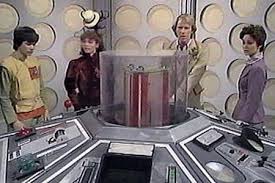
The Season 19 Team at full strength. Den of Geek.
     One problem that Five always suffered with, especially in his first season, was an overstuffed TARDIS. Adric, Nyssa and Tegan provided wide and varied personality types for the series to play with, but it meant that their characters didn't get any time to shine. I always preferred Nyssa to the other two because Tegan complained about everything and Adric is, well, Adric, but because of her less-than-outgoing personality type she never really got the right execution. She was the companion that could be afforded to spend an entire story sleeping, the one that could stay behind in the TARDIS to do the things that the script-writers could fit in anywhere else. Adric's death in Earthshock, while sad, is probably the best thing that could have happened to the season and after that Nyssa got notably more character development.
      That's not to say that the other companions weren't involved. Season 19's main plot was that they were trying to get Tegan, who had mistakenly wandered into the TARDIS in Season 18, back to Heathrow Airport in 1982 in time for her to get to her job as a Flight-attendant. This inadvertantly means that we get four stories where they land on Earth in various time zones, which to be honest is rather clever if productive of unimaginative settings. It works better as a theme than as an actual goal, as we see when we reach the dreaded Timeflight and Tegan actually ends up at Heathrow. The season was far better when it was exploring its own ideas, as we see in Four to Doomsday, Kinda and Black Orchid, and they're the ultimate standouts of the season.
6b_4
The Saward Cybermen... stand around.
     The Saward stories within Season 19 itself are of note. The Visitation was written before Saward became script editor, and was an audition of sorts for his suitability for the role. It does show his fascination with the 1600s as we'd later see many times in his historicals, and it does read a lot more like a radio drama than one often thinks. It isn't by any means a bad story, but it's nothing really interesting. Compared to that story, Earthshock is a completely different beast. It's a story that I've really beat on in the past simply because of how deriviative it is - it takes so many archetypes and ideas from the Alien franchise, and the JNT Cybermen aren't really used as anything other than a generic monster. It may be a great return to form for the monsters after their seven years away, but the story itself really bores me to tears and Adric's death, coupled with a suspense filled first episode, is the only real attraction.
     My favourite story of the season is by far Black Orchid, which is just plain fun in a more innocent era. It's very fluffy and at times the plot makes little to no real sense, but for me that forms part of its charm and there isn't a serial this season that gives me as much fun. Four To Doomsday certainly comes close to that, though, with its quirkily stupid plot and the really quite interesting concepts at hand. The best story of the season in the classical sense is probably Kinda, whose philosophies and ideas mix with great acting from all to make one of the most thoughtful serials out there. My least favourite story, and the winner of the covetted Bad Sci-Fi award, is Time Flight, which mixes an absolute lack of sense or reason with shoddy production values. The truth is, I even like that - it's a fun romp and it's nowhere near unpleasant.
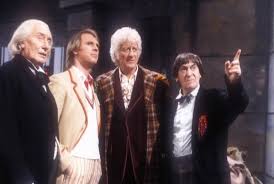
Three Doctors and a Bloke in a Wig
Season 20 - 1983, Peter Davison - Anniversary

Back in 1963, William Hartnell said of Doctor Who, "This will run for five years." Twenty years later, and the producers were due some rightful celebration. The Anniversary year revelled in its position, but it did suffer because of the stresses of what it had to do, and in the end it didn't turn out as well as it could have due to strikes and problems with writers. Season 20 saw Tegan come back, saw Turlough arrive, Nyssa leave and saw The Five Doctors come together to celebrate their acheivements. (Well, Three Doctors and a Bloke in a Wig.) Season 20 itself is a fair mix of very well-made stories with varying degrees of success, but there's a much higher standard overall and you can see the effort that they were putting in despite the problems with strike action.
     As part of the Anniversary Season, JNT brought back lots of former monsters and characters. In order, we saw Omega, Borusa and Gallifrey, The Mara, The Guardians, The Brigadier and The Master, followed by the epic Five Doctors special. Apart from Arc of Infinity, which flounders somewhat, all of this season's stories managed to take these guest stars and put them into interesting stories. And surprisingly enough, it never falls into the same trap that stories like Attack of the Cybermen later would - the mythology is not the most vital part of the story. It's merely complementary to an original, usually better, tale. Enlightenment is a great example. The Guardians from Season 16 form a large part of the story and the eventual conclusion features them heavily, but they're mere background characters in a space-epic about Eternals.
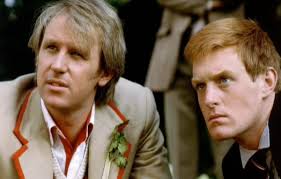
Five and Turlough get friendly.
     Companion-wise, Season 20 rarely feels as overstuffed as the previous season, despite at least one story with three companions. Nyssa's initial appearance as The Doctor's sole companion gives her the impetus for some serious character development that really helps to define the character and seperate it from the behind-the-scenes figure of Season 19. In fact, this development reaches its head in Terminus, which I still tear up at every time I see it. Tegan's reappearance is really, really stupid, and I had hoped that she would have been left behind for good. Apart from in the one Mara episode, the character floats along as the same caricature as before. She does get some decent work in Enlightenment, however, which is mainly due to the fact that during the Black Guardian Trilogy Turlough tends to act as his own entity outside the team. Turlough himself gets his best work here, as the confused boy fighting between his lust for power and his common sense of right and wrong. This really shows up best in Mawdryn Undead, with the rest of the trilogy (especially Terminus) consigned to quite petty villainy.
     The strike problems really show their head when you look at the season's semi-final story, The King's Demons. There in place of a Dalek story called The Return (later to be rechristened as Resurrection of the Daleks) it showcases the nadir of JNT's capacity for decision making in his use of Kamelion. The prop is damn creepy and is by far the scariest thing in a story which features duels, jousts and medieval torture devices. Luckily, the story is made up for by the Five Doctors, which is an absolutely astonishing effort and is the Saward Era's high point by a long shot. It's the story that got me into Doctor Who - the story that introduced me into this magical world.
Goodbye, Nyssa. "tear"
     Bests and worsts are difficult in such a good season, but my personal favourite of the season is The Five Doctors. The sheer spectacle of seeing the Who world pull together as it did makes this story an instant classic and will always be one of my favourite stories from the show. In the season-proper, my favourite is the moody Terminus, whose dark atmosphere is tempered with great ideas and a heart-breaking final scene. The most classically-good story of the season is probably Enlightenment, with it's Kinda-esque devotion to a high-concept sci-fi idea, or Snakedance for its fun take on the Mara and for Martin Clunes. My least favourite is by far The King's Demons, which, unlike its bedfellow Arc of Infinity, has very few redeeming features and features the damn-creepy Kamelion.

Season 21 - 1984, Peter Davison and Colin Baker - Darkness and Change

My viewing (and reviewing) of Season 21 has been incredibly topsy turvey. That could be the reason why my perception of the season is so fractured, but that also has to do with the way the season is structured as The Doctor loses companions and eventually changes himself. Season 21 would be the last time to date that a Doctor changed mid-season, and that's mainly because the reaction to the one serial with newbie Colin Baker was, to say the least, volatile. But for all of its sharp edges, the season has relatively few clunkers in my book, and the ones that are there are affected massively by production problems and not because of scripts.
The Myrka was the victim of bad budgeting.
     Margaret Thatcher's 1983 election robbed the production teams of several weeks, leading to Warriors of the Deep and The Awakening having some real problems on their hands, especially the former. That doesn't make them unwatchable, but both stories are notably incredibly pessimistic in tone. Warriors of the Deep is a quite contentious story for me - it's bad, and I can see that it's bad and I know why it is, but I can't help but enjoy it for its So Bad It's Good value. The Myrka is hilarious, Tegan's styrofoam door acting is terrible and vampiress Ingrid Pitt giving a judo-chop to the Myrka as a first line of defence is one of the funniest things in Doctor Who. It's a real shame that this still ticks people off, though, as this was inevitably the story that began the show's descent when Michael Grade got the wrong end of the stick.
      This season saw companions come and go a lot. Tegan disappears in Resurrection of the Daleks after one decent story in the form of Frontios, but the former story is often so confused with other things that it doesn't get to focus on her story. Planet of Fire sees the belated development of Turlough, and it all feels a tad rushed as we're supposed to absorb all this information about where Turlough is from, his relation to the people of the planet Sarn, why he was on Earth, who his parents were, and what his favourite colour is. It also introduces Peri, who in her three stories develops slowly into the form we see her in during Season 22. In her first story she gets a few decent lines, but Nicola Bryant's crisp English accent did cut through occasionally and her step-dad's accent was even worse.
29
Fighting for his life.
      We can't talk about Season 21 without mentioning the gamechanging Caves of Androzani and, conversely, the much-derided The Twin Dilemma. To be honest? I love both of them for very different reasons. Androzani is a powerful Shakespearean tragedy with great, great acting and a script that never lets up, and provides Davison with some of his best work for the program. It's not typical of his era at all - it's more of a callback to Holmes' 70s work - but it's still classically brilliant. The Twin Dilemma is just plain fun - a simple story with an entertaining performance by Baker, who manages to question our perceptions about the Doctor just enough for us to have to learn to trust him again. That's amazing.
      My favourite story of the season is Frontios, where Bidmead gets all of the characters dead on and mixes it with a great idea in the style that he's so used to. Frontios took a Tardis team that I was really down about and turned it into a great narrative combo. The most classically good is Caves of Androzani, which is Robert Holmes awesomeness in its purest form. My least favourite is The Awakening, which is utterly droll. I rarely have course to call Doctor Who boring - I think Boom Town is a classic, Terminus is a highlight and Black Orchid is fun - but The Awakening is by far one of the most irritatingly bland stories I've ever had to sit through simply because of the stupidity at the core of its central premise.


08
Sixy started off with a continuity drive.
Season 22 - 1985, Colin Baker - Sheer, unadulterated fun

Too many people beat on Season 22. The era was strife with publicity issues and it remains as what is oft-considered a dark age in the show's history. But for me, there isn't any problem. Against the odds, I enjoy every single story from the 1985 season, and despite the fact that some of the stories are a little fluffy, none of them are drastically bad in the way that, say, Time-flight is. Colin Baker is one of my favourite Doctors and over everything his Doctor is what makes 22 one of my favourite seasons in the Classic era so far.
      The dynamic between Six and Peri is an interesting one for me; while the pair are often caricatured as constantly fighting, but really the dynamic is more like a married couple (ooh, don't remind me of The Airzone Solution) where the two may argue, but they care for one another deep down. Colin's abrasive personality means that a lot of scenes occur where the two are just arguing; in my experience, this has led to some of the funniest and certainly weirdest lines in the era. Where would we be without, "Rest is for the weary, sleep is for the dead. I feel like a hungry man eager for the feast!" Despite being a bit of a tit at times, Baker's Doctor is a character that I absolutely love. He's like a sitcom dad. I like him for the same reason I like Stan Smith from American Dad - I don't agree with some of the things he does, but he's a character that is ultimately striving for good. Peri does spend a few episodes of the season as the token screaming companion - Mark of the Rani and Timelash especially - but she does get some further development. You could try a drinking game based on how many villains want to do the naughty with Peri, but I hear that stomach pumps are expensive nowadays.
18
Timelash is a bit off, but not as bad as it could have been.
      The program got in a lot of trouble for violence in this season, which is strange when one considers the relatively large amounts of violence and gore in earlier seasons that received only a harsh letter from Ms. Whitehouse. Attack of the Cybermen saw Sixy using guns, and the Cybermen squeezing Lytton's hands into a bloody pulp. Vengeance on Varos had the acid bath sequence (the guard fell in, he wasn't pushed, don't even try) and torture devices. The Two Doctors had the cannibal-esque Shockeye and his death via Doctor + chloroform. Timelash had the gory Borad. Resurrection of the Daleks had a mutated head begging for death, galaxy-wide cannibalism and a stabbing. There's no doubting that Season 22 is a dark one, but I don't have any problem with the levels of violence - I watched a few of these as a kid and it didn't do me any harm. As for the Doctor using lethal force - well, that's just who this Doctor is. He only killed a sapient being once, and that was in a script by the adored Robert Holmes. It's a lot of fuss over nothing.
     My favourite story of my favourite season is the excellent The Two Doctors, simply for how fun it is. The Sontatarans are good, the Androgums are interesting, the setting is beautiful and Two is still very much on form. The best classically good stories are certainly Vengeance on Varos and Revelation of the Daleks - both dark classics dripping with satire and strong messages. My least favourite is probably Timelash, simply because I didn't like the way that HG Wells was characterised. I did love its atmosphere though, and it's not as bad a story as people make it out to be.

21
The Doctor on Trial.
Season 23 - 1986, Colin Baker - Timelord On Trial

Ah, the hiatus. 18 months of pure stupidity. Not that Nu Who hasn't done similar (2009 comes to mind) but it was a statement from the show's executives that the series was listing in popularity. The series' ratings never returned to the heights of Davison's seasons post Hiatus and while this was probably the fault of the break there was one other contributing factor. The Trial season was one of the most outstanding concepts the series had ever undertaken, and it was almost inevitable that it would never reach the heights it wanted to on such a low budget.
     The season starts out strong with its first serial of four episodes, which return to the 25 minute format. Eschewing character development, Baker and Bryant have a much stronger chemistry and the atmosphere is instantly lightened. This does wonders for the story from a character point of view, but it does mean that the focus is elsewhere; Robert Holmes' penultimate script uses several of his Seventies trademarks (strange robots, comedy double acts - two of them) and quite a strong concept. Despite this, it flounders for the majority and relies much more on the strength of the Trial scenes themselves. The characters in these scenes make the best of the single set, especially Michael Jayston's Valeyard. The Valeyard's character is one of the most powerful of the Saward Era and the first serial of the season shows this off with great panache.
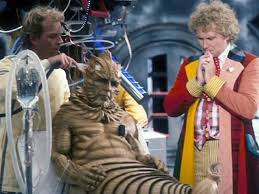
Mindwarp indeed. Better prosthetics =/= better story
     Mindwarp, the fifth-to-eighth episodes of the season, take on a much stranger notion. Written by Phillip Martin, the same guy behind the brilliant Vengeance on Varos, Mindwarp suffered a lot from the Trial aspect of the plot and while I admire a lot of the clever storytelling devices, it is confusing and at times unpleasant to watch. It tries to bring across the darkness of that first story into this season, and it just doesn't work with the Trial scenes. This season didn't need a brainwashed Doctor torturing Peri, it didn't need her to be brainwashed herself, balded and then killed by Brian Blessed (a fate worse than death.) The serial sticks out like a sore thumb, and while I like it, the story wasn't what the season demanded.
      And then we get to the dreadful, dreadful Terror of the Vervoids. I don't want to hate this story - it contains many things that I admire in other stories from the period. But the simple problem is that I think it doesn't contain any thought behind it. At least the silliness in Timelash was evoking plots from HG Wells, this is something like Day of the Triffids crossed with a back-door blue movie. Pip and Jane Baker... I could forgive them for other things. I don't think that Time and the Rani is as bad as most people say it is, and The Mark of the Rani was one of the most interesting stories of the previous season. But the tired Trial aspects, coupled with patronising storytelling and the rushed introduction of an incredibly annoying companion in the form of early Mel, really start to show the end of the era in ways that are immediately apparent.
24
The Doctor is in trouble one last time.
     Saward wanted a big end to the Trial season, and it was problems on the final serial of the season that led to his eventual resignation. Written by four different people over the two episodes, this leaves The Ultimate Foe as a demonstration of all that went wrong during Saward's final season. It was goofy, it had cheesy dialogue, and it was incredibly confused as to what it wanted to be. You could say that he never intended to leave, but the Trial wasn't the best finale that he could have given us as a script writer.

Conclusion

This has been a very cathartic experience for me. As I said before, this era is the one that brought me into the world of Who. It's been strange, and at times painful, but the era for me is never truly boring. There was always the best of intentions and in the long run, the struggle between Eric Saward's radio-drama ideals and JNT's mad whims created some of my favourite pieces of TV ever made. It's been a pleasure writing these reviews and I hope that you've had a pleasure (or will have pleasure) reading them.

Thanks.

Friday, 27 July 2012

Opinion: Bottom Five Worst Saward-Era Serials

See "Dr. Who" in the top bar for links to my reviews of the serials in question.

The Fifth and Sixth Doctors fall under the Saward Era, a period of the program oft looked down upon for some shabby scripts. However, most of the time I adore it - usually for the same reasons that other people dislike it. I think it's fun, and is a really rewarding area of the show if you're willing to look past the silly mistakes. Despite this, though, I have to be honest. There are some real stinkers in the Saward Era. And here are my Bottom Five Worst Saward-Era Serials.

Noble warriors become generic monsters.
5.) Warriors of the Deep - Season 21
Most people would expect Warriors to be much further down the list, but I really like its atmosphere and its themes. But even I have to admit that it has a lot of issues. The tone is overbearingly depressing,
the production is shoddy and the villains have little to no realistic motivations.
     In previous stories, the Sea Devils and Silurians had actual rhetoric; vaguely ecologically-based reasoning as to why they had the upper hand. Here they don't really feel unique in any way, and that makes a story already disadvantaged by lack of time worse. The Myrka I blame soley on Margaret Thatcher, whose sudden election cut two weeks off of the serial's production and ultimately is the serial's nail in the coffin.

Upsides
Ingrid Pitt karaté chopping the Myrka is funny as shit, and the serial provides quite an interesting examination of Cold-War politics.

This. Guy. Is. Creepy.
4.) The King's Demons - Season 20
The Ainsley Master was never truly well-written in the Saward Era, and The King's Demons is no exception. He ponces about yet again in an unnecessary disguise, and plans to stop the signing of the Magna Carta... an act that would do pretty much fuck-all. Even The Doc points that out.
       But the thing that really puts Demons on the list is Kamelion. He doesn't work as either a concept or as a prop, and he is damn creepy. They put this disembodied silver puppet on prime-time TV? Kamelion was ultimately a massive mistake, but unlike Planet of Fire, Demons has nothing to back it up with in the meantime. Ultimately The King's Demons is just a melting pot of bad characterisations and creepy robots.

Upsides
Gerald Flood's voice is pure gold, and so is the luscious period costume.

These Cybermen are too emotive...
3.) Earthshock - Season 19
Before you cry out in despair, this is a more personal one. I can see why people like Earthshock, and I recognise its place in Who mythos. But the things that some people can just ignore take over for me. The bad characterisations. The silly plot points. The Saward Cybermen at their very worst. Attack of the Cybermen was more about the Cybermen's mythos and had a variety of other characters and plotlines. Earthshock is a single-track focus on one silly storyline.
     The characters just feel so empty. Tegan and Nyssa do hardly anything, Five shambles about endlessly and Adric is less annoying than thoroughly bland. All the rest are just expies from a really bad Alien knockoff, and they, Beryl Reed especially, are simply annoying to me. Earthshock is a disappointing mess.

Upside
Adric dies.

Concorde Capers Cause Chaos
2.) Time-Flight - Season 19

Time-Flight is by far Five's worst story. What makes it worse for Saward is that it was originally given to the producers during the production of Season 15 and had been handed down through consecutive script editors until Saward was made to use it. Regardless, after the first twenty minutes we're well and truely in stinker territory. The Master is at it again with a different disguise, this time even more pointless, this time even more offensive.
       Time-Flight's key issue is not its characters, who are rather well-used if odd, but the simple fact that the ideas on show are so very poorly executed. The set filming in the Jurassic is ridiculous and the strange random monsters are completely ridiculous. By far the worst Master story ever besides The Movie, and the worst story of Five's Era.

Upsides
The location filming at Heathrow is excellent, and the Xeriphim are somewhat interesting. It is rather fun, and in recent months I've come to love it as a So-Bad-It's-Good classic.


Damn Vervoids.
1.) Terror of the Vervoids - Season 23
Terror of the Vervoids is the only Sixth Doctor story on this list, which may come as something of a surprise. Usually Colin can hold up a story enough to make me interested, but this is the one occasion where that simply isn't enough. If you ignore the fact that all of the other characters are completely bland and predictable, the story's death knell is Mel.
     I explained this in detail last week, so I won't say any more about how much I dislike Mel in Season 23. Even the Trial scenes are affected, bolstered with ridiculous logic and scenes that destroy the themes from Mindwarp. There's so much wrong with Vervoids, in so many ways, that I find it utterly irredeemable.

There are no upsides.

Thanks.